
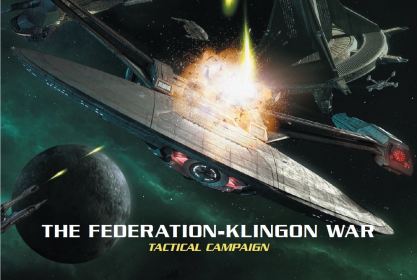
I’m back today with more about the Federation-Klingon Tactical Campaign, following my first part which focused on the book’s options for players and GMs. Really, last time was about all the stuff for Star Trek Adventures as you have probably been playing it with crews and away teams going on typical Trek adventures. This time we’re going to talk about what’s truly different with this book, the tactical campaign itself.
Setting the Stage
It’s said throughout the book but it’s worth repeating here: this style of game has more risk than your average Star Trek Adventures game. War is a heady subject and making sure folks are comfortable, mentally healthy, and engaged with the story is trickier for a GM shaping a wartime story. The advice here sets you up well for some success, though, starting with establishing a Session 0 with your players. This is a great idea for every game where you establish a few things about the universe (important even for a setting with canon like this) and the characters. A follow up discussion of Safety Checklists (with subjects expertly termed Always OK, Yellow Alert, and Red Alert) and other safety tools really sets the right tone.
After that comes Planning the Campaign, and this is where we begin to see how much things will diverge. The Tactical Campaign from the book’s title is more than just a clue to the subject matter inside but it’s a reframing of how to structure a Star Trek Adventures campaign for your players. While you could have an episodic campaign within a greater war (Star Trek: Deep Space Nine did it very well), you can also tell an extended and coherent story of different sides in the war struggling for victory and survival. To accomplish this, The Federation-Klingon War Tactical Campaign breaks up the conflict into three Campaign Stages (Early War, Mid-War, and Late War) within which are three Campaign Turns that divide things further.

Events and Assets
Given that this conflict has a canon timeline and has already been explored through one vessel’s experience (the U.S.S. Discovery while it was around), GMs might be wondering how they can have their players meaningfully contribute to the story of the Federation-Klingon War. To kick off the war there’s a “scripted event” (the Battle of the Binary Stars on May 11, 2256) whose outcome is established and known. Players and GMs know the events there (or can watch them in the two-part Star Trek: Discovery pilot) and think about how the news (or the direct experience) impacted their characters. Then there’s an unscripted mission similar to a typical Star Trek Adventures experience, followed by another scripted event. Continue through the nine different Campaign Turns, ending with the ceasefire between the Federation and the Klingon High Council on September 14, 2257.
But there’s more! To begin each Campaign Turn the players take a high level look at their Available Assets. These are different things like starships, expeditions, local resistance fighters, supply chain resources, etc. You generate points of interest for this Campaign Turn (a star system with something drawing attention like a colony in need or a strange signal) and the players start discussing. This is likely out of character as the decisions of the Starfleet brass (unless the PCs are Starfleet brass themselves) but one point of interest will be the scenario that the crew plays out and the others will receive one, some, or no assets depending on how important the players think it is. Scenarios are standard mission experiences but points of interest that get assets assigned will have a single role against a Difficulty. They can succeed, partially succeed, fail, or seriously set the war effort back.

Example Campaign Turn
For example, let’s generate some points of interest for an imaginary campaign starting from the beginning. The Battle of the Binary Stars is a few weeks behind us and this new ship, the U.S.S. Montauk is headed out into the fray. A “regular pace” in the Early War is to start the group off with five random assets and generate five points of interest. The assets available to the players are going to be Admiral Shukar, the Walker-class U.S.S. Thunderbird, Ensign J.T. Esteban, Consul St. John Talbot, and some retired Federation ship. All of the named assets, by the way, appear later in the book as we’ll see. The points of interest are going to be a Federation-friendly world threatening to defect to the Klingons, reports of an enemy assassin, a visit to a Federation-friendly world to show the colors, a patrol mission in Federation space, and a secret research site thought to be testing illegal weapons.
Each of these threats has a type and Difficulty while each asset has a set of abilities for each type. The world that’s threatening to defect, for instance, is a Social problem with a Difficulty of 2. That’s nicely within the wheelhouse of Consul St. John Talbot so he’s going to deal with that. Meanwhile the illegal weapons is a Personal 1 problem and that’s something Ensign Esteban is good at so he’ll go there. The patrol mission will be handled by the U.S.S. Thunderbird with the prototype tech (which I’m deciding is a disabling energy weapon) sent along for good measure (the tech will “assist” on the roll for better results). Admiral Shukar will handle the Federation world in need of reassurance and the crew will track down this assassin.

Now comes the tricky part. The GM allows the characters to pick the next mission which means they have to have five potential missions prepped, right? Not necessarily. They can time things so that the crew picks a mission at the end of a game session and they have until the next game session to get that mission together. This doesn’t always work out, though, which is why this book comes full of Mission Briefs and short mission write-ups covering all three stages of the war. Chapters 4, 5, and 6 cover nearly one hundred pages and they are full of missions to run with… but this is a task designed for a GM who is comfortable flying a little fast and loose with things. For instance, with these theoretical players picking the assassin mission I comb through my options and find the “What Follows” Mission Brief in the Discovery Campaign Guide. This fits well enough that I can run with this, but it again requires me to have a different book than just the core rulebook and this Tactical Campaign. You can also just wing it by whipping up a Mission Brief of your own and vamping but that’s not everyone’s comfort zone.
However you do the scenario, afterwards you can see how your assets fare. In my case, the missions by Ensign Esteban, Consul St. John Talbot, and the Thunderbird all got exactly the number of Successes needed for their missions’ Difficulties. The Thunderbird rolled a 19, though, which is almost a critical fail (a 20 in the Early War and with a wider range later) that would have made it a Flawed Success and had some negative consequence. But that didn’t happen and instead Admiral Shukar really blew it out of the water and got an extra three Successes above the Difficulty which gives me three Campaign Momentum. I bank this separately from my other Momentum and can use it to help future asset missions or buy new assets. All of these situations are now off the board and I can generate new points of interest for the next Campaign Turn. If they stuck around, though, they might get worse and create headaches. The players all get Progression, though, and can improve their characters but they can also roll on the Progression Table to see what improvements Starfleet makes as a whole (more resources, emergency aid, etc).

Additional Options
One great thing here is a long discussion of how to make custom assets. You could, of course, just come up with some names and use the ratings from existing assets (maybe switching around their strengths) to make your own things. If you wanted to make assets out of existing characters or ships, however, you can follow these guidelines to quickly translate them into
You can, of course, play through this same approach from the “other side.” With the Klingon Empire Core Rulebook, you can move through the Campaign Stages and Campaign Turns with a Klingon crew. You’ll be in even more need of Mission Briefs and Scenarios, though, as these are fewer than Federation ones but if you’re comfortable inventing on the fly a little that’s not as much of a barrier. There’s also a description for a “Trading Game” of war profiteers, civilians like Harry Mudd riding out the conflict and trying to come out ahead. You could even use the Player’s Guide to make some Romulan infiltrators, opportunistic Vulcan Logic Extremists, or any other scenario you can think of for a crew that is watching the conflict from the side and deciding what opportunities to take. The further you move from the default framework of a Federation crew on a Starfleet vessel, however, the more homebrewing you’ll be responsible for.
A sidebar at the end of this section deserves an especial note in this review. All of this deploying of resources and such can be played as a solo game as well (I just did it above, in fact). You could see about the experiences of a particular ship during the war but you can also combine this book with Captain’s Log to have a singular character’s point of view. It works much the same: assign your assets, leave one point of interest to be your Captain’s Log mission play-through, then regroup afterwards. This is my personal plan following up on this review and I can see it having a lot of utility, particularly with an adaptation to the Dominion War, Klingon Civil War, Cardassian War, etc.

Conclusion
There’s a lot of great stuff in the rest of the sourcebook (the stuff I talked about last time) but really what we’re talking about here is some real innovation. This is a big picture sort of thing that offers a chance at a different style of Star Trek, the sort of thing that takes it beyond what we typically see on the screen. Star Trek is a detailed and multifaceted franchise and there’s room for many kinds of stories beyond the single ship focus that a TV format requires. Even still, there’s other examples of this big-picture thinking in Star Trek from the armadas of The Next Generation and Deep Space 9 to the Starfleet-wide situations seen in Picard and Prodigy and even the later seasons of Discovery.
A while ago we got some fleet rules from the Command Division Sourcebook and I thought they were alright but ultimately I haven’t used them at all in an actual game. Looking back, I’m realizing that what I wanted out of those Admiralty rules were these Admiralty rules. Now that we have them, I’m looking ahead to my next Star Trek Adventures and Captain’s Log games with very different ideas.
Leave a Reply