
By Stephen Near
A while ago, I wrote about players leaving your game by being put on the metaphorical shuttle and replaced by a new character. I’m guessing this is pretty common as it’s happened several times—with myself and other players—in my long running Shackleton Expanse game. From a TV perspective, our four seasons have seen a rotating cast that rivals the kind seen on DS9 or (its sister show) Babylon 5.
In this final Trexit post, I’m writing about two different kinds of departures, ones that deal with sending established characters in a bold or risky new direction. Both are rewarding and offer dramatic potential if handled properly.
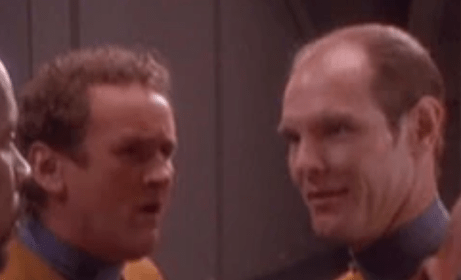
The O’Brien

Miles O’Brien, the famed lower-decker who climbed the ranks from nameless red-shirt to mainstream character, is a cornerstone of Trek.
A loyal jobsworth who typically assisted in operations tasks, O’Brien became instrumental in filling in the background of the Federation’s conflict with the Cardassians. His rough-hewn background, coupled with a straightforward perspective, essentially made him the show’s ‘everyman’. When he moved to Deep Space Nine, his backstory opened up many more dramatic hooks, adding the kind of depth and hardship audiences rarely saw on TNG.
So, how does this apply to Trexits? Well, suppose you’re playing in one Star Trek Adventures game but want to move to another?
Maybe your old game is ending, your schedule is changing, or you simply want to play a different story with a new crew. But you really want to bring your character—and all they’ve experienced—into the next adventure.
This Trexit essentially says goodbye to one version of the character by reintroducing them to you and another game.
Rather than taking the old character’s Values, Focuses, and Talents, consider how leaving one setting (or show) will influence the move to the new one.
Very likely, the character will receive additional training, so consider changing some Focuses and Talents (a must if they’re changing departments).
But a shift in Values is also needed. Ask yourself what the new story of the new game represents for the character. Are they older and wiser or embittered and seeking redemption? Is it an exciting new chapter, or are they haunted by the past? In this sense, the Value changes encompass both the character’s reinvention and the direction of the new campaign.
In the case of O’Brien, Engineering Talents and Focuses from a TNG game might be devoted to Transporter technology with Values reflecting his devotion to duty. But after his exit and starting a DS9 game, he’d have a wider array of Engineering Talents and Focuses while changing his Values to represent his devotion to Keiko and his wariness of Cardassians.
But there’s more than one way to rewrite a character for a game, and this last Trexit is perhaps the most controversial.
The Eddington

Introduced in the third season of Deep Space Nine, Eddington was a by-the-book Starfleet Security Chief who frequently rubbed his station comrades the wrong way. As the season progressed and the Dominion threat began to heat up, Eddington’s perspective made him more relatable.
Then, everything changed.
In a face-heel turn, Eddington betrayed his comrades and joined the Maquis. He would go on to become a persistent thorn in the side of Sisko as he attacked both Starfleet vessels and Cardassian settlements. After his capture, Eddington would return one last time to work with Sisko against the Dominion before finally meeting his end.
Unlike other Trexits, where the character maintains allegiance to the cast, the Eddington remakes the character as an adversary, with the shift being secret and ending in betrayal. Sounds fun, right?
Not so fast. Years of playing a vampire LARP have shown me just how deeply players can be affected by character treachery. So, handling an Eddington will depend on your cast. If you think a character could potentially be a betrayer, or a player has told you they want to explore it, you should discuss it with the group.
Some players might be fine with a traitor in their midst. For others, it’s a no-go. Remember, we come to the gaming table for different reasons, and Star Trek is often seen as a genre where people work together to solve problems. Personal conflict is to be expected; outright betrayal is rare. So, take the time to talk it out.
Indeed, consulting other players can allow them to invest their character to an even greater degree with the betrayer-to-be. A perfect example of this is the complicated relationship between Commander Chakotay and Seska on Star Trek: Voyager, where the ship’s XO was suddenly confronted by his lover-turned-traitor to the Kazon while also being a Cardassian spy (yikes!).
For The Eddington, Focuses and Talents can largely remain unchanged while the Values see an almost fundamental shift. As a Starfleet officer, Eddington might start with a standard Starfleet Value like “Loyal to the gold uniform” or “Just doing my job” only to suddenly switch to “Fight for a Higher Cause” or “Open your eyes” (thanks Tony Pi!) when his face-heel turn occurs.
Players, and their characters, can’t always stay with a given game. But using these, and the previous Trexits, will hopefully give you some engaging examples of how to use departures for the best dramatic effect.
While I’m here, I have to offer a shameless plug for my newest (and first official) contribution to Star Trek Adventures in the Mission Brief: Political Actions available for FREE at Modiphius!
While I’m here, I have to offer a shameless plug for my newest (and first official) contribution to the Star Trek Adventures in the Mission Brief: Political Actions available for FREE at Modiphius!
TM & © 2026 CBS Studios Inc. © 2026 Paramount Pictures Corp. STAR TREK and related marks and logos are trademarks of CBS Studios Inc. All Rights Reserved.

Leave a Reply to Stephen NearCancel reply