
[I apologize in advance to anyone who is offended by my cross-pollination of IPs. I don’t apologize for being the ultimate geek for writing this.]
In the world of science fiction, where space battles, time travel, and alien encounters are part of the everyday, there is one constant that fans have come to appreciate: characters who can calculate complex probabilities and percentages in a matter of seconds. From C-3PO in Star Wars to Spock in Star Trek, these characters add a layer of logic and mathematical precision to their respective universes. But how do they do it? And, more importantly for tabletop RPG players, how can you infuse these skills into your Star Trek Adventures RPG character?
In this blog, we’ll explore the mechanics behind those iconic on-screen calculations and provide tips for bringing that same flair to your RPG sessions. Let’s dive into some of the most memorable instances of quick calculations in sci-fi and uncover how you, as a player, can give your characters a sharp edge in calculating the odds.
[Also, at the end of this blog, we provide an out for people who pass out trying to keep up with this heavy math.]
C-3PO and the Asteroid Field Odds

One of the most famous examples of a sci-fi character throwing out improbably detailed odds comes from Star Wars: The Empire Strikes Back. As Han Solo navigates the Millennium Falcon into an asteroid field to escape the Empire, C-3PO panics and exclaims, “Sir, the possibility of successfully navigating an asteroid field is approximately three thousand seven hundred and twenty to one!” Han’s response? “Never tell me the odds.”
While C-3PO’s number might seem like it came from thin air, it’s not entirely unreasonable to assume that a protocol droid equipped with vast amounts of knowledge and computing power could make this kind of calculation in real-time. C-3PO likely used data from previous encounters with asteroid fields, factoring in the Falcon’s speed, agility, and the density of the asteroid field. He may have run some quick probability analysis based on similar scenarios stored in his memory banks, generating an accurate (though anxiety-inducing) figure.
In an RPG setting, this kind of calculation could add tension and excitement to a space chase or battle. If you’re playing a character like a science officer or an AI, consider using real-time data analysis to provide critical (but sometimes unwanted) insight into the odds of success. Just be prepared for your captain or pilot to dismiss your calculations in favor of gut instinct!
Spock and the Exponential Tribble Population
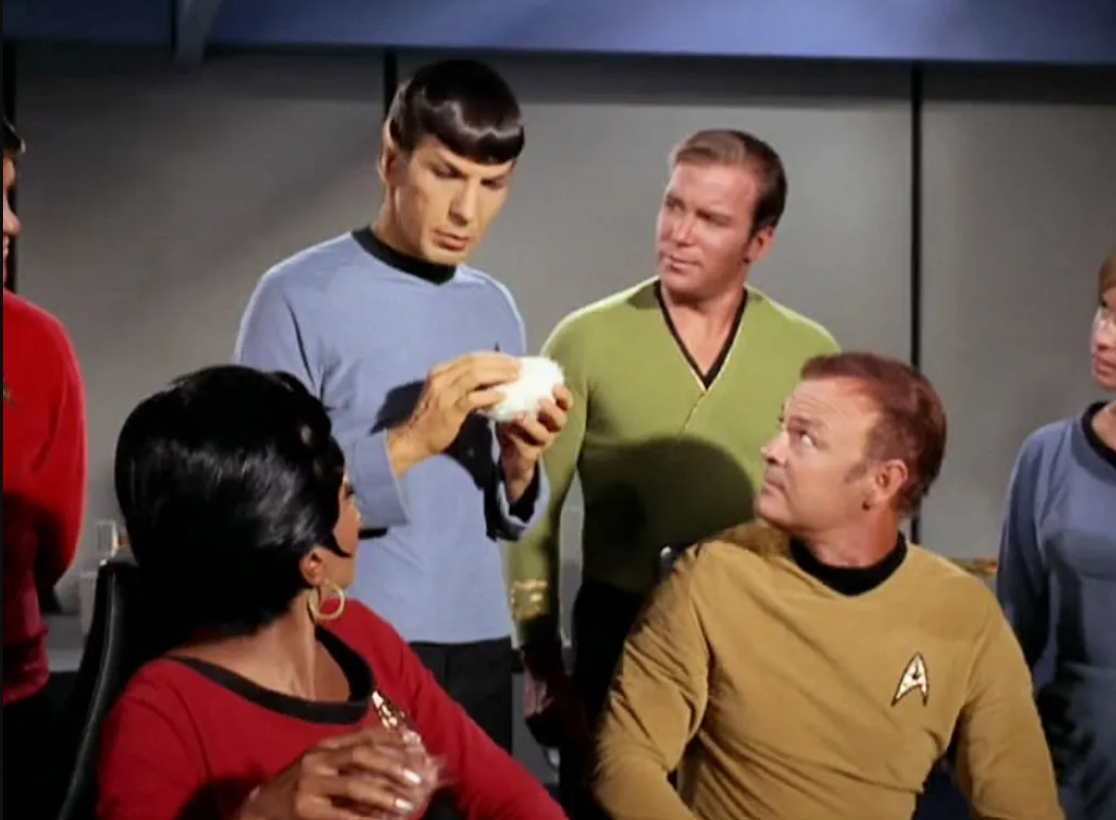
Now, let’s turn to the Star Trek universe and one of its most iconic characters—Spock. In the Star Trek: The Original Series episode, “The Trouble with Tribbles,” Spock applies mathematics to a rapidly reproducing species of fluffy creatures called tribbles. When Kirk asks Spock how many tribbles are on board, Spock effortlessly calculates: “One million seven hundred seventy-one thousand five hundred sixty-one. That’s assuming one tribble, multiplying with an average litter of ten, producing a new generation every twelve hours over a period of three days.”
Spock’s mathematical brilliance shines here, and his ability to provide an exact number demonstrates his Vulcan precision and logical approach. The exponential growth formula Spock employs is familiar to anyone who’s studied population dynamics. He assumes that each tribble produces ten offspring, who will, in turn, reproduce every twelve hours. Over three days, this leads to an explosive population increase, calculated through repeated multiplication.
In an RPG like Star Trek Adventures, such precise population modeling or resource management could be crucial for characters during missions that involve biological threats, survival scenarios, or even predicting enemy fleet reinforcements. If you’re playing a science officer, mathematician, or tactician, you can use similar logic to calculate the odds of survival or to predict how a situation might evolve. Incorporating detailed mathematical predictions adds depth to your character and offers a tactical advantage to your crew.
How Do They Do It?
Though characters like C-3PO and Spock make it look easy, calculating odds and probabilities in such detail requires a good understanding of basic mathematical principles—something sci-fi writers love to infuse into their scientifically-inclined characters. But you don’t need to be a math whiz to emulate these characters in your RPGs.
Exponential Growth – When it comes to population or resource growth, the formula for exponential growth comes in handy. For instance, Spock’s tribble calculations follow this basic principle:

Using this formula, Spock quickly predicts the rapid expansion of the tribble population.
Probability of Success – When C-3PO gives the odds of navigating the asteroid field, he’s probably using a form of probability that takes into account multiple variables. For your RPG character, you could use a simple probability formula to estimate success:
This is useful when your character needs to assess the likelihood of something happening, whether it’s dodging asteroids or surviving a firefight. While the math behind C-3PO’s quote might be more complex than this, simplifying the idea helps in RPGs.
Tactical Calculations – In many scenarios, knowing the odds can be a matter of life and death. Think about your character’s role on the crew and how they might contribute to decision-making with math. Tacticians could calculate fleet movements based on speed and trajectory, medical officers could project survival rates, and science officers could predict environmental hazards.
Integrating Probability and Math into Your Star Trek Adventures RPG
The beauty of Star Trek Adventures RPG is that it already has a strong emphasis on science and logic, making it easy to incorporate quick probability calculations into gameplay. Here’s how you can emulate characters like Spock and C-3PO Data in your sessions:
- Science and Engineering Roles – Characters in these roles are perfectly positioned to make rapid calculations. You can use basic math formulas to predict outcomes for your crew, such as estimating the time until a ship runs out of power, calculating the rate of hull deterioration, or determining the optimal speed for warp travel to avoid a dangerous nebula.
- Combat Calculations – Tactical officers and pilots can use probability to estimate the chances of successfully hitting an enemy vessel or evading a threat. For example, using range, speed, and shield strength, you can make educated guesses on whether an evasive maneuver will work or if you should prepare for impact.
- Decision-Making and Risk Assessment – A well-timed probability calculation can turn the tide of an RPG session. When faced with a difficult decision—whether to engage a hostile force, attempt diplomacy, or retreat—having a character who can quickly assess the odds of success can inform your team’s strategy.
Don’t Be Afraid to Tell the Odds
While characters like Han Solo might not want to hear the odds, knowing them can often be the difference between success and failure in RPGs. By incorporating quick probability calculations and exponential growth models into your Star Trek Adventures gameplay, you can create a character as sharp as Spock or as data-driven as C-3PO Data. Use these tips to add depth to your sci-fi RPG sessions and help your crew make decisions grounded in logic, science, and just a bit of fun math!
“But wait a second,” you say. “I can’t do math like this in my head, much less on a sheet of paper. This blog was a total waste of time.”
Not so. Tune in tomorrow for “Simulating Probability with a D20 in Star Trek Adventures RPG“.
Leave a Reply to Simulating Probability with a D20 in Star Trek Adventures RPG –Cancel reply