
Hello readers!
Recently, while I was researching my last article on Samantha Wildman, it got me thinking more about parenting, as well as the role of family, in Star Trek Adventures.
The importance of relatives to a character’s story has been a long-standing tradition in the canon of Star Trek. From parents like Benjamin Sisko, who are actively engaged in their children’s lives, to those with more complicated parent-child relationships, like Sarek and Spock, the interactions between a player character and their family helps us understand them better. Let’s talk about some ways we can add a regular or recurring family member to our Star Trek Adventures characters.
When discussing scenarios in this article, for the sake of simplicity, I will be using service on a Starfleet vessel or station as the default for discussion. However, feel free to apply any of these ideas to whatever military or exploratory organization is the basis for your particular campaign.
Adding a Family Member: Should You Do It?
Before we begin, it’s important to consider whether having a family member on your ship with you is a viable option for your table. Here are two points to ponder:
Is my campaign era-appropriate to allow for a civilian family member to accompany my character? For example, it would be unusual to have relatives on board a ship during wartime, or prior to the mid-2300s.
Is the ship or station on which I serve set up for families? Most stations can usually accommodate families, but not always. Specialty stations such as a remote outpost or top-secret research station might not be the best fit. Starfleet vessels have similar issues. While larger deep space exploration vessels like the Enterprise-D were designed with schools, recreation centers, and other institutions to accommodate civilian needs, smaller vessels on different missions may not have those specialized functions.
In either case, check with your Game Master to see if adding a family member would be appropriate for your campaign.
The Expanding Idea of Family in Star Trek
You have had the necessary above-table conversation with your GM and considered your campaign setting, but what sort of family involvement do you want, and how will they fit within your character’s story? Let’s walk through some of the possible options.
Option One: Your Character is a Parent
As seen with examples such as Ben and Jake Sisko, Rom and Nog, Samantha and Naomi Wildman, and Beverly and Wesley Crusher, being a birth parent is the option that has the most representation on screen across Star Trek canon. However, biological children aren’t the only option to becoming a parent. Iconic characters who were adopted like Michael Burnham, Worf, and Seven of Nine’s informal adoption of Icheb represent another avenue to parenthood.
Additionally, sometimes a player character can find themselves the unexpected guardian or mentor of a child… an event that can shake up their storyline. Captain Picard, infamously uncomfortable around children, once found himself a reluctant foster parent to Jono (Jerimiah Rossa) during the adolescent’s custody process. Paul Stamets and Dr. Culber enthusiastically took on the role of ‘friends as family,’ proudly mentoring young Adira as they navigated their acclimation to both serving on Discovery and being host to the Tal symbiont.
Regardless of your character’s path to parenthood, a child can help them explore their personal growth, how they handle the passage of cultural milestones, and the unforeseen rewards and difficulties that caring for a child brings. Being a parent also allows your character to reflect on their own upbringing, what type of parent they are choosing to be (and why) and the decisions that led to becoming a parent.
Speaking of which, ask yourself, does your child have another parent, or maybe, is your character part of a larger parenting group? There is a wealth of cultural possibilities related to that question. Are you raising the child alone? If so, where is the other parent (or parents)? As it was on Voyager, are there other members of the crew like Neelix who help you with parenting responsibilities? It does take a village, or a crew, after all, when you are 75,000 light years from home!
I should mention at this point that parenting is not just for organic life forms. To quote Counselor Troi in “The Offspring,” “Why should biology rather than technology determine whether [she’s] a child?” Examples include Data’s first child, Lal, about whom Troi was referring, and the Doctor’s photonic children, Jeffrey and Belle, and then later his surrogate parenting of SAM (Series Acclimation Mil). If your character is synthetic or photonic, how did your children come into existence? Do you struggle to help them relate to organics? Or, are they better at these relationships, and help you instead?
Option Two: Another Member of your Family is On Board
Although the parent-child dynamic is the most common form of family found in Star Trek, there are other possibilities.
You could serve alongside one or more of your parents as fellow officers or crew, such as Captain Freeman and her daughter, Ensign Beckett Mariner from Lower Decks or Scotty and his nephew, Midshipman Peter Preston in The Wrath of Khan. Or, you could serve with one or more of your siblings, like the Delaney sisters on Voyager. Or, you could find yourself stationed with the sibling of a parent, or a cousin, or some other familial combination. This could be a compelling source of support or friction, depending on the dynamics of your game. Some helpful questions to ask yourself might be: how did you end up on the same ship together? Are you the same rank, or is there a rank difference? Who outranks whom? How do differences in rank or position affect your relationship?
In a similar vein, with civilians present on certain assignments, another member of your family could be on board for different reasons. Maybe you have a sibling with a child who is interested in Starfleet, and you’ve agreed to let their child shadow you for a few months? Perhaps an older adult in your life has never been off-world, and they are accompanying you for the adventure? Or, you have an older parent who is recently widowed or otherwise lonely, and bringing them on board allows you to spend more quality time with them. An adult relative might also be on board with you to help you with child care.
Continuing that theme, thanks to advanced holographic technology, we’ve even seen instances of Star Trek characters consulting with holographic representations of family members who have passed, such as Data’s creator (Noonien Soong), Wesley Crusher’s father (Jack Crusher), and Hugh Culber’s abuela. It can be a provocative idea, but who would you bring back, and why? Perhaps you’re at a point in life or your career where you are missing their mentorship? There’s potential for meaningful moments on the holodeck, where the advice or wisdom of an honored elder or treasured loved one helps you through a difficult time.
Option Three: The Surprise Drop-In
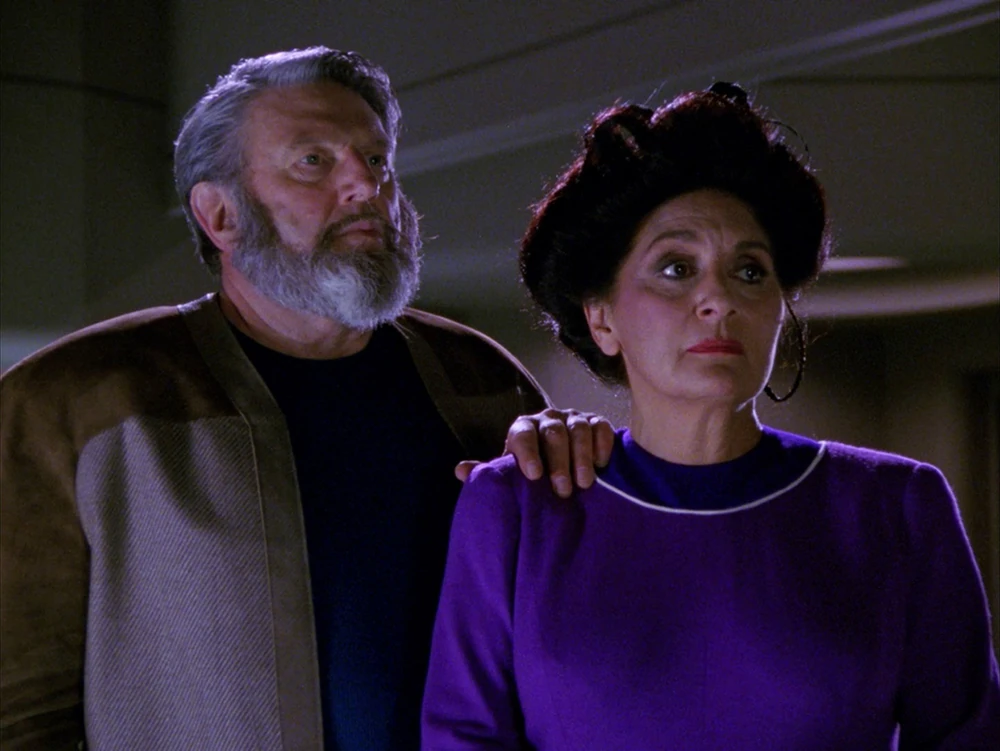
If you’re not interested in having regular family involvement, but want to have the chance to introduce your character’s past into the narrative, have them occasionally drop by. Work with your Game Master on who it would be, whether or not the drop-in is related to the “A Plot” of a mission, how they have found themselves on your ship or starbase, and what the nature of your relationship is with them. Is it benign like Sergey and Helena Rozhenko’s visits to the Enterprise-D? Or does it cause shenanigans, like when Andy Billups’ mother, Queen Paolana of Hysperia, appears and shakes things up?
Using Game Mechanics to Represent a Family Member
Two of the most accessible ways to make an on board or visiting family member impactful to game play are to represent them as a Trait on your character sheet, and/or to represent them as a supporting character.
Traits
The use of Traits is outlined in detail in the Core Rulebook. In essence, a Trait is a word or short phrase that tells you something important about your character. You include it on your character sheet when it’s significant enough to affect how your character makes choices or what drives and motivates their actions. It’s a characteristic that players and GMs can use when a circumstance warrants changing the difficulty of a scene. Typically, this plays out by raising or lowering the difficulty of a Task by 1. Sometimes, depending on whether or not the Trait is considered beneficial or detrimental to a scene, a GM can decide to have it affect the Momentum cost as well.
During character creation, or anytime after, you can ask your GM to allow you to add a family-related Trait to your sheet. A Trait could be as generic as “Parent,” “Caregiver,” or “Guardian,” or something more specific, like “Mother of Naomi Wildman,” or “Guardian of Jeremiah Rossa.” Like other Traits, these apply so long as that condition is relevant to your character. Situation-oriented Traits, like the temporary foster arrangement of Jeremiah Rossa by Captain Picard, tend to be shorter-term. They can be removed if and when the character’s circumstance changes.
You can brush up on how Traits are used by players and GMs in the Star Trek Adventures Second Edition Core Rulebook on pages 87, 250-253, and 321-322, or in the Star Trek Adventures Second Edition Quickstart Guide on pages 7-8.
Supporting Character Sheet
Making your family member a supporting character allows you to better shape who they are and what they can do in a scene. It also gives some guidance to your GM how they should be played, and allows other players, or yourself, to step into the role as the circumstances of a scene dictate. When creating your family member’s sheet, think about revisiting the “Upbringing” stage of your own character’s creation process (Stage 3), and incorporating a few of those characteristics like values, focuses, attribute bonuses, et cetera into the family member’s stats. Directions for creating a Supporting Character are found in the Star Trek Adventures Second Edition Core Rulebook on pages 144-147.
Story Arc and Complication Matrix
No article on family in Star Trek would be complete without including some ideas on how to put them in mortal peril, so here’s a chart! Roll a d20 to select one at random, or choose one from the list that suits your current mission.
| D20 ROLL – RESULT |
| 01 – Differences of opinion between you and a family member are causing you to test or challenge one of your Values. Work with your GM on the center of the conflict and which of your Values will be challenged. |
| 02 – A younger family member has managed to sneak an endangered or dangerous creature on board, and some feature of its biology causes ship-wide malfunctions. |
| 03 – A bounty hunter is looking for your family member, or someone that looks just like them, and they attempt to take them into custody. |
| 04 – A family member who is a Starfleet Flag Officer has sent you an “informal” request that directly contradicts your Captain’s mission directive. |
| 05 – Your family member is trapped in a damaged part of your ship and is losing life support quickly. |
| 06 – Your family member is in sickbay and their treatment requires you to undergo a surgery. Mark an amount of Stress on your sheet determined by your Game Master. |
| 07 – A superior officer or visiting flag officer has a bad history with your family member, and they project those past grievances onto you at every opportunity. |
| 08 – An ambassador or representative of an enemy of your government reveals to you that you are both related, and now Starfleet Security has begun a formal inquiry. |
| 09 – A family member’s cultural, moral, or spiritual beliefs are at odds with a mission, and they are causing obstacles to mission progress. |
| 10 – A gifted younger member of your family has hacked into your encrypted mission ops briefing to use for a school project, jeopardizing the mission. |
| 11 – Your family member’s fascination with an aspect of the ship’s functioning has inadvertently caused systems to fail throughout the vessel. |
| 12 – (for characters with the Telepathy or Empathy Talent) A family member is going through a difficult emotional time, and you are having trouble filtering out their intrusive thoughts and feelings, causing you to be distracted. |
| 13 – A family member is playing matchmaker, and has arranged for a potential suitor to visit your ship under the guise of a mission specialist. This causes you numerous distractions. |
| 14 – For some reason in your family member’s past, they have diplomatic immunity during a mission with a particular culture, and their partying or other problematic behavior is complicating the mission. |
| 15 – An eccentric relative has died and left you an alien relic of significant cultural value that was stolen centuries ago from an enemy of the Federation. That enemy tracks the property down to your ship and demands its immediate return, but your family member doesn’t want to give it up. |
| 16 – You are expected to participate in a crucial family ceremony or tradition (in person or via subspace) that requires specific and time-consuming rituals during a crisis. |
| 17 – (For Klingons) A challenge has been issued by a rival house, and your family member insists you initiate a Blood Feud! (For non-Klingons) While on leave, a family member stumbled into a debt to a criminal organization like the Orion syndicate, and they have come to collect. |
| 18 – You receive news that a traveling family member has been trapped in contested space. |
| 19 – A family member has among their personal belongings a seemingly benign family heirloom or artifact that reacts dangerously to an anomaly in nearby space. |
| 20 – Your family member has become a minor celebrity after publishing an exaggerated and embarrassing tell-all holonovel about you and your shipmates, causing animosity amongst your crew. |
In closing…
I hope this article provides some inspiration and ideas for your games. If you want more guidance on this topic, the Star Trek Adventures Player’s Guide has some excellent insights. Here are some specific topics:
- Advancement and Milestones for Mentorship (pp. 198-199)
- The history of family on ships in Star Trek (p. 175)
- Mental health benefits of traveling with family (p. 176)
- Playing children and the Child role in Star Trek Adventures (pp. 179, 199-202)
If you have any other ideas, or want to share your own PC’s stories of how their relatives impacted a campaign, feel free to let me know in the comments below.
Until next time!

Leave a Reply