
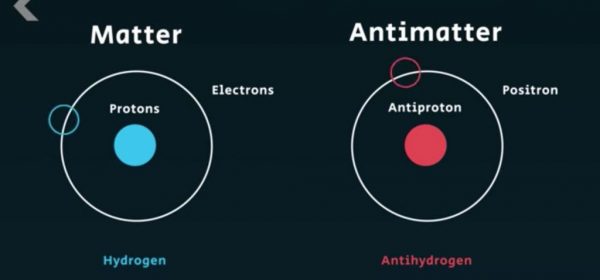
 Anti-matter is a staple of Star Trek, and without it, the mighty starships of Starfleet wouldn’t be what they are in the show. But what is anti-matter and how can you get it into your game outside of main engineering? Why should you deal with it outside of a warp core?
To put it simply, anti-matter is just like regular matter except that it has oppositely charged subatomic particles making up its atoms. Protons are negatively charged and called anti-protons, and electrons are positively charged and called positrons.
What makes it such a great fuel for starships? When antimatter encounters regular matter it annihilates itself along with an equal amount of matter. (E=mc^2, folks) The amount of energy released from that destruction is immense.
In my previous article, I wrote about a one-kilogram amount of anti-matter being released by a shuttlecraft crash causing an explosion equivalent to a 47 megaton nuclear explosion.
Anti-matter is just like regular matter except that it has oppositely charged subatomic particles making up its atoms.
To put that into more context, a fully loaded Galaxy-class starship would have around 3000 cubic meters of anti-matter on board. Assuming it is partially frozen anti-deuterium, that would be an explosion of around 23,124,000 megatons. Take that in for a second. True, it is only 0.5% of the amount of energy expended during the K-T event (the meteor that killed the dinosaurs). However, the K-T event did not release incredible amounts of gamma and x-rays.
So we should all feel amazed when Enterprise had a warp core breach in orbit of Veridian III and the low orbit blast somehow didn’t irradiate half the planet with hard radiation, thereby causing some weird and deadly chemical reactions in the upper atmosphere that would ensure acid rain for decades to come.

I’ve shown that Starfleet ships with warp core breaches are generally mass extinction events waiting to happen. How should a responsible Gamemaster put this madness into your game?
The first step is telling stories about where anti-matter comes from! Today, scientists are able to generate anti-matter in minuscule quantities using particle accelerators. How would the Federation scale this up billions or trillions of times? It all comes down to how much power you want to throw at generating anti-matter.
 It’s my theory that the Federation would use close solar orbiting power stations collecting immense amounts of energy and utilizing that to generate anti-matter. You would not want these facilities on or near a world (see above). You would want it near an energy source that would be far more powerful than what your own fusion reactors could make, so a star is the clear cut answer. Plus, if the anti-matter station cooks off, it’s still just a drop in the bucket against the backdrop of even a small and dim red dwarf.
It’s very possible all inhabited star systems in the Federation have one of these anti-matter ‘collectors’. Just as likely, Starfleet has dedicated facilities around stars in uninhabited systems that would be used as fuel depots of a sort. These space-based complexes would be massive, require huge solar shields to protect the work areas from the nearby star, and have truly colossal solar high-efficiency solar panels that would require little to no maintenance.
A gamemaster could write whole adventures around a crew being tasked with solving engineering issues cropping up in Anti-Matter Station 6 in Wolf 359. Or perhaps the skeleton crew of Starfleet reservists has had a murder onboard their station giving your players a new and interesting take on a closed-room mystery.
These same near-solar stations store massive quantities of anti-matter. Hence, they would be natural rendezvous points for starships as they will always need to refuel. They could even become logistical centers for Starfleet. During a war, these facilities would not only be important waypoints for starships going to the front lines, but also strategic points that the Federation would defend with passion. The construction of one of these facilities in a newly-welcomed member world’s home system could be the center for diplomatic intrigue from factions in the new world’s government or even from hostile nearby powers.
Another way of introducing anti-matter into your game is through convoys, an old staple of war stories from the mid-20th century. Even in the 24th century, it would make sense that large quantities of anti-matter would need to be moved from places where it’s produced to places its needed. Perhaps there is a shortage due to war in a sector and moving anti-matter close to the front is a better solution than having starships leave the front lines and move back a few light-years to refuel.
Perhaps a facility has been constructed that is mass-producing photon torpedoes and is in need of warhead material.

Regardless of the reason, a character’s starship can be assigned to escort a specialized anti-matter transport. Nothing should put a transport or escort;s crew on edge than being near enough weapons-grade badness to crack a planet in half.
Here is where I will give a very rare piece of rules advice: if said transport is destroyed, assume that any starship inside short or medium-range is also destroyed. At long-range, a starship may survive in pieces, but her crew will likely be radioactive biological goo spattered about the remaining bulkheads.
As the gamemaster, you should always remind the players of just how bad anti-matter is to their long term health if they do not respect its power. There will be no, “Oops! Magnetic containment just failed on the anti-matter storage tanks. I better fix that!” There won’t even be a bright light. All they’ll get is an epilogue where a non-warp capable civilization a couple light-years away is wondering why there is a new star in the sky that fades away after a day.
Que the ending theme music.


Leave a Reply