
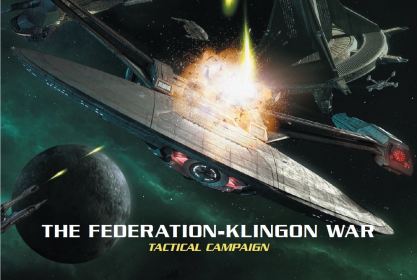
The latest sourcebook out for Star Trek Adventures is a different sort of take on the Star Trek franchise. The Federation-Klingon War Tactical Campaign is firstly a guide to the conflict seen in the first season of Star Trek: Discovery. It’s got resources for any 23rd century (and beyond) game, but more than that it offers a different tone and structure from other Star Trek Adventures games. Let’s take a look!
Character Options
The first part of a book is all about the characters, and The Federation-Klingon War supplement offers plenty of new options. As always, these options slot beautifully into all your existing Lifepath options so that you can easily add in species and experiences specific to this time period into your existing Star Trek Adventures game. For instance, a “Random Species Table: Mid-2200s” is provided so that you can have players all choosing from the same palette (though they are also not locked in). This table features Andorians, Denobulans, Humans, Tellarites, Trills, and Vulcans from the core rulebook as well as Arbazans, Caitians, and Edosians from the Alpha Quadrant Sourcebook; Aurelians and Efrosians from the Beta Quadrant Sourcebook; and Barzans, Osnullus, and Saurians from the Discovery Campaign Guide.
New species options in this book are the telepathic Aenar, the pacifistic Arcadians, the centaur-like Ariolos, the imposing Betelgeusians, the beleaguered Coridanites, and the aquatic Megarites. Some of these are featured in the first couple seasons of Star Trek: Discovery and so fit into the theme of the Federation-Klingon War but a good number are deep cuts that should make a lot of diehard fans happy. I will say that the table makes clear folks playing a campaign in this mold are expected to have access to a fair number of Star Trek Adventures books, and not just for species. That’s great for longtime fans but could be a drawback for others (in which case I’d direct them to our Species Index to pad out their list).

Next up we have Wartime Traits to add to your character. I’ve said it before but Traits are an underutilized part of the system in my experience but I think they’re great. For a small mechanical benefit (being able to petition for a reduced Difficulty based on your Traits), you have license to add in clear descriptors of what you think is important to your character. In theory, the list here of “Diplomat” or “Refugee” is just a collection of words that anyone could come up with. On the other hand, a few paragraphs discussing what it might be like playing a refugee is very helpful and things like Prisoner of War, Non-Violent Resister, or War Researcher might not be things you have thought about adding to your character before.
Similarly, the Values offered by the book are things you could come up with but sometimes it’s nice to have inspiration to draw on. Have you considered giving your character the Values “Take any deal for peace, even a bad deal” or “Find courage in the heart of despair” before? Even if these don’t fit your character goals, I imagine they make you think of some other angles that would! Same for the two dozen new Focus ideas (four for each Discipline) that come next. Slightly more mechanical is a list of six Career Events which are more war-focused and can replace the first six results on the standard Career Events table.
There’s plenty of crunch in the Wartime Talents section with Talents like Combat Gunner and Focused Fire. One of the interesting applications of this section is creating character who are more effective in traditional RPG battlemap conflicts (and drawing from other 2d20 games like Achtung!Cthulhu or Infinity could provide even more). I can’t name a time when I felt a Star Trek Adventures character was missing out on weapons mounted to ground vehicles or clearing zones with difficult terrain, but if there was a time it would be a Federation or Klingon soldier during this war.

New Character Roles are also offered here include the Admiral and Intelligence Officer (which both appeared in a much shorter form in the Command Division Supplement); the Ambassador and Political Liaison (which appeared in the Player’s Guide); as well as the Combat Engineer, Field Medic, Heavy Weapons Specialist, Ordnance Expert, Reconnaissance, and Squad Leader (all four of which originally from the Operations Division Supplement). Several roles haven’t appeared before, both related to ship weapons: the Armory Officer who excels at dealing damage and the Tactical Officer who gets more effects. There’s also discussions for the ten Federation roles from the core rulebook and what sort of duties they play in wartime.
Lastly, this character chapter has a brilliant section on The Trauma of War which attempts to introduce some of the post-traumatic stress felt by real life soldiers and as seen in Star Trek: Discovery. With Suppression of Values you can have a situation conflict with a character’s Value or a mission Directive, prompting the player to either overrides with a Determination, takes a Complication from the tension, or challenges their Value to gain a Determination but also a Scar (physical, emotional, or reputation). Scars act like permanent Complications and can increase difficulty with a reward of Determination, but accruing too many can leave your character unable to properly function. This dovetails with an Accelerated Development system for rapid increasing in ability through the pressure-cooker of wartime. Another fantastic addition is Casualty Reports which has you take stock of who’s been lost after a bout of starship combat. We first saw this in the Gamemaster’s Guide but it fits so well with the tone of a wartime campaign that I’m very glad they reprinted it here.

Equipment and Starship Options
One section I skipped above with character options deals with Weapons and Gear for starships during times of war, and I was surprised by how useful I found this section. If you too were expecting “photon torpedoes and phasers but lots of them,” then I think you’ll be pleasantly surprised. From using the “stun” setting on ship phasers and utilizing point defense systems against incoming torpedoes, to “hot loading” torpedoes with extra bang (with added risk) and planetary defense systems, there’s a lot of food for thought here.
Some important options for ships, though, include simplified multi-ship combat, variations on Direct Tasks and assigning Power to ship systems, or chases. For characters there’s guidance on stealth missions and some alternate Initiative rules for a different combat feel.
On the topic of large scale conflict, though, the book has a rundown of UFP and Klingon Fleet Organization as well as how the fleets interact and are supplied. You can also use Swarms of Ships to create threats out of smaller vessels, something that players might already be familiar with from the Command Division Supplement. Specific Federation ships get write-ups for use by your group (as a main ship, a featured ship, or in the large-scale play we’ll get into next time. The Daedalus-class U.S.S. San Juan, the Intrepid-class U.S.S. Wallaby, the Walker-class U.S.S. Thunderbird, the Shepard-class U.S.S. Laika, the Magee-class U.S.S. Olds, the Cardenas-class U.S.S. Jervis, the Hoover-class U.S.S. Negrelli, the Malachowski-class U.S.S. Raskova, the Engle-class U.S.S. Rickenbacker, the Nimitz-class U.S.S. Fletcher, the Hiawatha-class U.S.S. Dove’s Dream, the Scout-type U.S.S. Cygnus, the Constitution-class U.S.S. Merrimac, and a Vulcan Science Academy Research Facility station. Most of these classes’s spaceframes are covered in the Discovery Campaign Guide so if you don’t have that this is a bonus look at mid-2200s Federation ship classes.
On the Klingon side we have the Qugh-class I.K.S. Qob, the D5 class I.K.S. Qu’QaH, the Raptor-class I.K.S. Vav’QoQ Ngem, the Daspu’-class I.K.S. Po’Tel, the Na’Qjej-class I.K.S. ‘ughnes, the EtlH-class I.K.S. tun SuS, the BatlH-class I.K.S. Tlhuh, the Qoj-class I.K.S. Qoj (first of the class), the BortaS bir-class FaH’nav, the Sech-class I.K.S. Saq’tin, the bird-of-prey I.K.S. Mesh’gah, the secretive Chargh-class I.K.S. 157, the Na’Qjej-class cleave ship HuH’gat’s Glory, the prototype D6 class ship, and the D7 class I.K.S. K’t’inga. Many of these ships come with the Stealth Systems Starship Talent, a precursor to the Klingon cloaking device appropriate to this time period.

Allies, Adversaries, and Appendices
There are plenty of NPCs to use in your Star Trek Adventures game set in this period. Administrator Nancy Hedford, Commodore Robert April (earlier in life than the version appearing in the Command Division Supplement), Admiral Shukar, Admiral Terral, Ambassador Robert Fox, Consul St. John Talbot, and Lieutenant Lawrence Styles. There’s also an unnamed commodore in charge of a Destroyer Squadron of three ships and a profile for a MACO officer. For the Klingons we get Dennas of House D’Ghor, Ujilli of House Mo’kai, a generic Battlecruiser Flotilla General commanding multiple ships, a generic Minor House Leader should you need one, and a QuchHa’ infiltrator (a ridgeless Klingon able to blend in).
This is a lot of material that’s useful for this campaign type but I think you’d really need the Discovery Campaign Guide (and, ideally, the Klingon Empire Core Rulebook) to feel like you had enough threats to fill out missions. The appendices are useful, with a Campaign Mission tracker (for the framework we’ll look at next time), a player version of the same, and a safety checklist form. The book really does set you up with a lot to be successful even if it seems designed to supplement other books’ contents.

Next Time…
While this might seem like a full book, I skipped over a huge section in the middle. That’s because the middle section is about the Campaign Play Framework that’s really the most interesting part of the book. In many ways it’s the most interesting part, however, it’s also the most involved so I want to take my time with it and this is already a long review. Tune in next time to see how you too can see the wonders of commanding fleets and holding the Federation together with duct tape!
Leave a Reply