
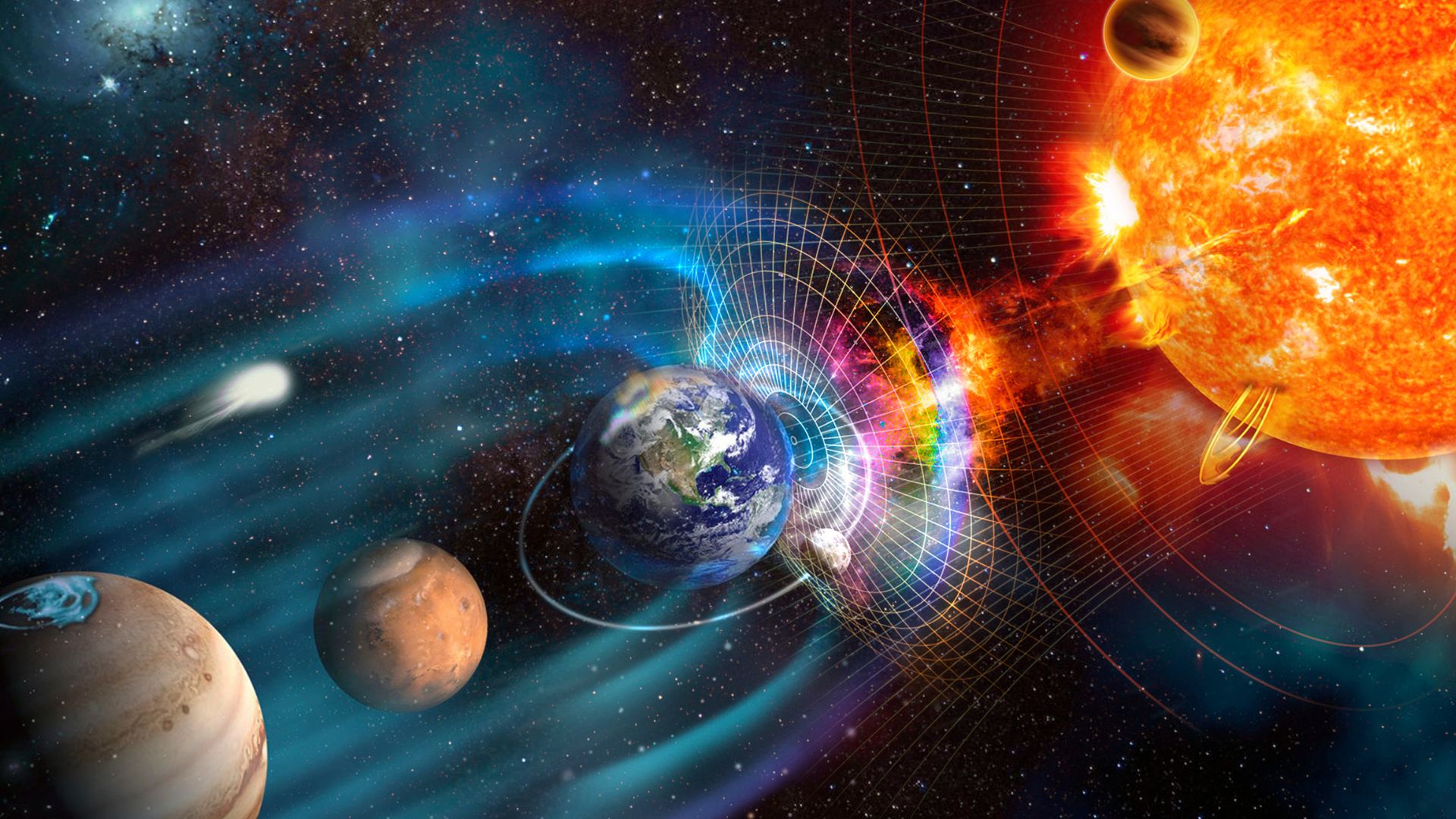
(Photo courtesy of LASP Space Weather Data Products & Resources)
By William Parker
In this article, I wanted to set out to create some fun space like random encounters that can be thrown into a game without derailing it. A problem I had with a lot of “Ocean Encounter Random Tables” is that they were either combat-focused or had a mystery. And with Starfleet officers, you can’t drop a mystery into the game without them going 110% into it.
So I set out to make a random table of Space Weather. These are just natural events that can happen in deep space and are things you might have to deal with. But they are not so interesting that they can derail a session… unless they get extreme. This is a 1d20 table, and each line has the title of the event and a brief explanation of what it might be. I took inspiration from Age of Sail events that made for fun interactive moments and just face-rolling the Standard Model until something interesting fell out.
Notice I did not put how to SOLVE these events. These are meant to be things that you dealt with until you were out of range of it, usually after a shift or a day.
Feel free to drop these in as flavor text, or as traits to complicate a long journey between systems. Or have a whole session about dealing with a particularly nasty case of space weather.
| 1d20 | Event | Description | Escalation (for when you have Threat) |
| 1 | Ion storms | Electrical storms that can roll out over light years Obscure sensors | Deals electrical damage to the ship. Can deal electrical damage to personnel as it electrifies the deck plating |
| 2 | Gravitational Break waves | Caused by Ion Storms, subspace events, or large Gravitational effects They swell and can buck the ship. 1-5 second swells every minute or so. Can force a ship to slow down or force a check to see how well you can navigate a wave | Severe waves need an extended task to get out of the region Can break the warp bubble and cause the ship to fall out of warp, dealing damage |
| 3 | St. Elmo’s fire | A pretty aurora-like effect That can build up over the bow of a ship at warp Caused by a gas cloud being ionized and blue-shifted as it hits your warp bubble. | Can obscure long and short-range sensors |
| 4 | Space whales! | Gentle giants come along ships and pick up their warp field to move between star systems. Follows alongside until they get close to a decent system for them, then they peel off. | Can become aggressive if agitated or their young are threatened |
| 5 | Tetryon Haze | A random static appears on subspace and EM frequencies. | Particularly bad haze can even affect internal wireless communication. Can blind sensors and scramble communications |
| 6 | Muon Shroud | Muons from a nearby star bind up the bussard collectors and cause the ship to build up heat. Usually just upwards of a bright summer’s day heat | It can get to uncomfortable or dangerous levels for the crew if not remedied. |
| 7 | Asteroid Storms | A large tumble of Asteroids is moving at significant speed across your path | Going around will take a long time, but going through would require careful navigation. |
| 8 | EM Storms | A Large surge of Electromagnetic energy. Can affect conventional electronics and computers, leading to computer errors or glitches | In severe cases, can cause charges to jump between wires, dealing shocks to the crew. |
| 9 | Plasma Storms | A storm of highly charged plasma, ala the Badlands | Can create charged eddies that are drawn to a ship’s impulse engines. Storm fronts can cause damage to the ship. May require an extended task to get through safely |
| 10 | Solar Storms | Most likely to occur close to a star. Can cause a build-up of plasma along the shield emitters, causing subspace drag | Severe cases causing shorts and shield grid failures |
| 11 | Meteoroid shower | A cloud of small rocks and ice, smaller than a centimeter each. Will pelt the hull constantly, causing a loud drone or a hiss sound to emit across the ship. Can become annoying if too loud | Can cause damage if the shards are heavy enough |
| 12 | Anti-Photon fog | This causes all light sources to be dimmed and dull | Severe cases can black out entire ships |
| 13 | Sub Space Squalls | Disrupts subspace continuity and forces a ship to lower warp speed, and reduces FTL sensor range | High intensity can force a ship to drop out of warp entirely and wait it out. It can distort visual star fields making it difficult and disorientating to navigate. |
| 14 | Plasma Fog Bank | Causes by the left over ejecta from a supernova or a CME. Leaves a smearing of energized particles across the way that can blind the microwave-ultraviolet EM bands, making it hard to see and use short range sensors | Severe storms can cause total visual blackouts and can affect targeting sensors and visual scopes |
| 15 | Radiant Gas Shoals | Caused by escaping gas from a passing gas giant or a deep space comet collision. Can create visual mirages that can confuse sensors and visual navigation | High intensity can reflect sensors pings and create ghost. It also makes it difficult to maintain cloaks. |
| 16 | Neutrino Gust | Caused by a burst of Neutrinos by a nearby supernova, or a pulsar. Mostly harmless, but gust can disrupt isolinear and quantum computers | High intensity gusts can cause issues with sensor resolution and delicate equipment |
| 17 | Proton winds | High-velocity stream of protons ejected from a magnetar Interferes with shielding, requiring extra power to stabilize them | Severe winds can disrupt magnetic bottles, Yes THOSE Magnetic bottles |
| 18 | Space Plankton | A shroud of deep space plankton meeting and glowing. Mostly Harmless | Might get into ship interiors and cause illness or allergic reactions. Severe cases can cause severe reactions and can gum up vital equipment |
| 19 | Subspace Kraken | A large-scale 4-8 creature that submerges in subspace and attacks passing ships for their warp cores. Keep your distance and you can observe | Get up close and personal and fight for your life. Even worse, give it a black hole-nest of scale 2 Baby Krakens to defend. |
| 20 | Roll twice and combine effects |


Leave a Reply to Saul SchimekCancel reply