
By Bill Barbato
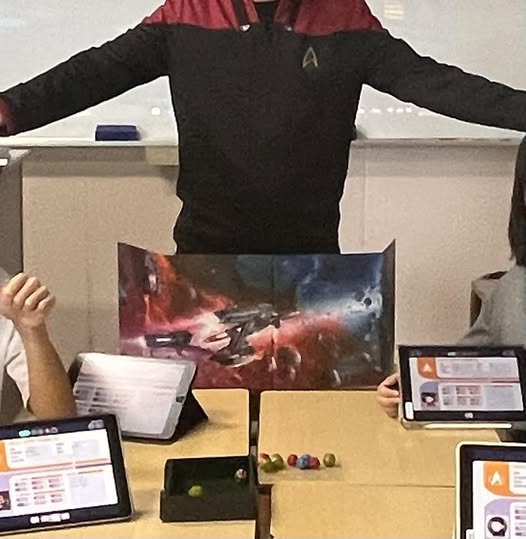
As some of you may know, this year I created a Star Trek elective course at the high school where I work. Originally, I wanted it to revolve around playing Star Trek Adventures and Captain’s Log, but I realized I first needed to build a foundation for the students to know what Star Trek is.
While there are a few older fans around, I’d venture to say that the majority of modern Japanese high school students know absolutely nothing about Star Trek at all. So, along with my co-teacher, I developed a course centered on watching a selection of episodes and completing a wide variety of activities inspired by those stories. My hope was that, once they gained some familiarity with the world of Trek, they’d be ready to become Starfleet officers in the roleplaying game.
From Zero Knowledge to Starfleet Cadets
Another challenge quickly surfaced: not only did my students come into the class with zero Trek knowledge—they had also never played, or even heard of, tabletop roleplaying games.
Over the term, I gradually prepared them by having each student create an avatar and fill out a character sheet. Meanwhile, I designed a simple adventure that would pull from everything they’d seen and learned. Everything built toward our first-ever roleplaying session, scheduled for the next-to-last day of class.
That day was yesterday.
Although I’ve been a Forever GM for 25 years, I was more nervous than usual. This session was full of firsts:
- My first time running a game without any of my usual gaming friends.
- My first time running for a group that wasn’t a cohesive friend circle.
- My first time running for players with zero roleplaying experience.
- And my first time running a game for non-native English speakers.
My goals were equally daunting: create a game that was easy to understand for ESL learners, approachable for newcomers to Trek lore and technology, finish in under two hours, engage shy high school students, and be memorable enough to spark a lifelong interest in both Star Trek and roleplaying.
Launch Sequence: Game On
Before the session, I sent a short explanation to the students to familiarize them with roleplaying basics. I kicked off the scenario with a simple directive written on the whiteboard:
“As Starfleet cadets returning from a training mission, you are asked to check in on a nearby icy planet where contact was lost with the stationed scientists.”
We began by establishing who was manning which stations on the runabout, and then jumped right into action.
An intense subspace transmission from the planet disrupted the runabout’s power, sending it into a crash landing. The pilot—Cadet Winters, the shyest student in the group—made the first task roll of the day. After walking everyone through the dice system, he rolled a 1, earning two successes on one die. The runabout landed safely, and the class erupted in cheers. The energy in the room completely shifted.
It was the perfect start.
Learning Through Play
As the two hours passed, the students grew more confident and began truly engaging with the game. The biggest challenge, however, was decision-making speed. Having never played a TTRPG before, they were still learning how to think collaboratively.
Complicating matters was a common cultural dynamic in Japan: most groups require consensus before acting. Every time a decision was needed—no matter how small—the game paused while the group sought complete agreement. Even then, few would voice whether they agreed or not, which slowed the pacing.
Because of that, I doubt we touched more than 10% of what I’d prepared! Still, I was able to adapt the story on the fly, letting their creativity steer the narrative without any railroading.
Highlights from the Adventure
Some standout moments included a Moopsy encounter that caused delightful chaos when it landed on a cadet’s helmet and tried to bite through. The group debated whether to phaser their friend’s head to save him. Ultimately, they tried punching the creature off, only for it to leap to another cadet—who was then accidentally shot by a teammate’s panicked blast.
Hilarity ensued, the Moopsy escaped, and the table was roaring with laughter. All of it emerged from a few perfectly timed Complications and a player’s choice to Succeed at Cost.
The conclusion was even more memorable. Two cadets found the station’s transporter room and discovered a pattern stored in the buffer. Fearing it was another creature, they fled to rejoin the group. Meanwhile, the others accidentally released a herd of Moopsys while disabling the interference signal.
In a final dash to escape, one cadet volunteered to stay behind to manually beam everyone to safety. After sending off the last of his crewmates, he set the controls to transport himself—and rolled a critical success!
That success not only saved his life but also brought the stored patterns to the runabout. The patterns turned out to be the missing scientists—rescued at last!
By sheer chance, the students achieved their mission’s goal.
Final Reflections
The session was a success—filled with laughter, surprises, and teamwork. One student remained disengaged, and another took time to find their footing, but even they had their moments of connection by the end.
I was both pleased and proud of how it all came together. More importantly, I hope this will be a memorable and influential experience for them—a story they’ll look back on fondly when they think about Star Trek or gaming.
I learned a lot from this session, and I’m eager to apply those lessons when the next group of students begins their term in two weeks. With any luck, we’ll expand on the roleplaying portion and boldly go even further.
About the Author
Bill Barbato is an educator, Star Trek Adventures RPG writr, and lifelong Star Trek fan who combines storytelling, language learning, and tabletop roleplaying to inspire creativity and collaboration in his students.
Leave a Reply