

I’ve read the first issue of Christopher Cantwell’s new Star Trek series from IDW, and Jim Johnson and I recently interviewed Chris for Continuing Conversations. The best description of what he’s doing comes from Chris himself: “I wanted to go forward, forward, forward. Brand new, not look back. But at the same time, you can’t not look back.”
As a Trekstorian, I spend an unreasonable amount of time looking backward. Chris has the opposite assignment: take 60 years of history and move beyond it. Five years past Picard, Seven of Nine — my favorite character in all of Star Trek, full disclosure — has the center seat of the Enterprise-G. Her crew includes a Cardassian tactical officer with a Dominion War past, a new executive officer who used to run Memory Alpha, and a Bajoran who serves as both counselor and chaplain.

Then Chris sends them out of the galaxy. “We’re outside Federation territory. We’re outside any territories, and we’re not mapped.”
Game masters, read that line again. That’s not just a premise. That’s a campaign frame.
An unmapped galaxy is a GM’s dream
Most Star Trek Adventures campaigns operate with Starfleet Command a subspace call away. Cantwell removes the net. No reinforcements, no rulebook with all the answers, no precedent to hide behind. Every first contact happens somewhere the Federation has no practical authority — which means your players have to be the Federation, improvising what that means in real time.
If you want to run this, steal the structure wholesale: a long-range explorer, a crew assembled from interesting friction, and a region of space where no chart exists. The blank map is the point. Let your players name things. Let them get it wrong.
Build the crew from friction
Chris didn’t assemble a comfortable bridge. A Cardassian tactician who fought in the Dominion War now serves a Federation that once bombed his world. An XO whose last job was curating all recorded knowledge now has to operate where none exists. That Bajoran counselor-chaplain isn’t window dressing — when fear starts doing its work on this crew, she’ll be the load-bearing character.
For your table: build player characters and supporting characters with built-in tension, not just complementary skills. The Memory Alpha XO is a beautiful archetype — the expert whose expertise just ran out. Hand a player that concept and watch what happens.
Make “diplomacy first” a table rule
Chris told us his operating principle for the series: “Diplomacy first.” He doesn’t want phaser fights every five seconds. He even joked about one of my favorite Star Trek tropes: “It’s a trope of Star Trek where something could be annihilating everything and someone goes, ‘Could we reason with it?’”
Exactly.
At your table, try making this an explicit campaign Directive: the scary thing approaching the ship is not automatically the monster. Understanding what you’re facing is the story. In STA terms, that’s extended tasks, social conflict, and Threat spent on complications rather than torpedo spreads. The opening arc of this series is a psychological thriller about fear — fear of the unknown, fear that makes some of the crew want to keep going and others want to turn back. Run that with your Threat pool and watch your players squirm in the best way.
The real engine: exploration versus colonization
Here’s the question that should power your campaign. The expedition in Star Trek #1 includes Romulan refugees searching for a home, and the story keeps circling the uncomfortable line between exploration, expansion, and colonization. Chris said the story eventually confronts this head-on: “What gives you the right to tell us what to do?”
Give that question to your players and refuse to answer it for them. Seven of Nine is the perfect viewpoint character for it — she spent part of her life in a Collective where authority was absolute, then operated outside Starfleet as a Fenris Ranger, and now she represents the Federation in a place where the Federation’s authority is mostly theoretical. Every prime directive dilemma your table has ever debated gets sharper when there’s no admiral to appeal to.
Three adventure seeds, free of charge
The flotilla. A Romulan refugee convoy asks for escort through unmapped space to a rumored habitable world. Protecting them means spending resources you can’t replace. What happens when the rumored world is already inhabited?
The cartographer’s dilemma. The crew discovers something extraordinary — and realizes that charting it for Starfleet is also claiming it. Who gets to put a name on a star?
The right to command. A civilization in the new galaxy demands to know by what authority these strangers act. “What gives you the right to tell us what to do?” isn’t a villain monologue. It’s a fair question. Let the players answer it.
The right books for the job
If this kind of campaign appeals to you, two recent Star Trek Adventures releases were practically built for it. The Exploration Guide gives you the tools to create new sectors of space, new planets, and new biomes — the literal blank map this premise demands.
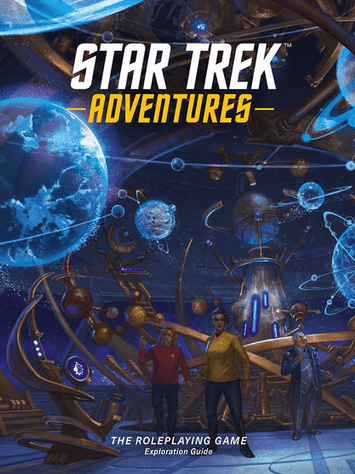
And the Species Sourcebook does the same for the people you’ll meet there: sixty alien species templates plus guidance and mechanics for creating your own original species. New worlds and new civilizations, straight off the shelf, ready for whatever your players name on that map.

Why this excites me
Chris knows he has 60 years of Star Trek sitting behind him — “They really did give me the whole box of crayons,” as he put it. Issue #1 suggests he knows he doesn’t have to use every color at once. And Dennis Menheere’s artwork paints what Star Trek feels like rather than what it looks like, which I think is exactly the right instinct for a story about going where no map exists.
For those of us running games, that’s the invitation: take the whole box of crayons, pick a few colors, and draw somewhere nobody has drawn before. Forward, forward, forward.
Read my full piece on the series: “Forward, Forward, Forward”: Christopher Cantwell Takes Star Trek Into the Unknown
Watch our full Continuing Conversations interview with Christopher Cantwell: https://youtu.be/X2YJYH2fVik
Leave a Reply