Most gamemasters who have run a mystery know the moment. The crew has a victim, a strange substance, and a suspect list as long as the duty roster. The players have been talking for twenty minutes. Theories are flying. Suspicions are hardening into accusations.
And nobody has rolled a single die.
That stall is where whodunnit adventures tend to go to die, and it usually isn’t the players’ fault. Theorizing feels like investigating. It isn’t. On Star Trek, officers solve mysteries by going places, scanning things, questioning people, and testing samples — by gathering evidence, not by debating in the briefing room. When my own table hit that wall recently, I stopped the game and said something close to this:
“I’m hearing theories. I’m not hearing a line of inquiry. If this was a TV show, what would you expect to see people doing?”
Then I gave them the tool this article is about: investigate the nouns.
Contact at the Scene. The senior officer names an Investigative Lead — preferably a player character. The Lead makes contact with whoever holds the scene, learns what kind of investigation this is (engineering, medical, security, or science), and gathers the basics: location, victims, witnesses, suspects.
Preliminary Survey or Scene Walk-Through. Before anything gets touched, the team walks the scene, sets an entry path that won’t contaminate it, and works out what needs recording, what needs collecting, and what needs a lab.
Scene Capture. Record everything as it was found — the wide view, the midrange view, the close-up — so the scene can be rebuilt later, on a holodeck or around a conference table.
Collecting Evidence. Gather trace and biological evidence systematically: where it was found, what it is, what condition it’s in, how it was packaged, and who has custody of it.
The mechanics in that article still work, too. Most of those tasks sit at Difficulty 0, and the Momentum players generate gets spent on Obtain Information — the spend that turns “we search the room” into specific, case-moving answers.
What eight more years of running these games has taught me is that the procedure answers the wrong first question. Players rarely stall because they don’t know how Starfleet investigates. They stall because they don’t know what to investigate next. That’s the gap the nouns fill.
First, walk the scene. La’an Noonien-Singh, James T. Kirk, and Spock search the derelict USS Griffin before they touch anything — tricorders out, questions ready. (Star Trek: Strange New Worlds, “The Griffin Incident.” Photo: Paramount+ via TrekMovie)
The Nouns Method: A Job Aid
Here is the five-step version of what I did to walk a stuck crew through an investigation — generalized so you can run it at your own table, whether you’re the gamemaster or the officer holding the tricorder.
Step 1: Stop theorizing and put a lead in charge
When the conversation circles back to the same suspicions, say so out loud: theories aren’t evidence. Then ask the question that tends to unlock the scene: “If this was a TV show, what would you expect to see people doing?” Players can picture a Star Trek investigation even when they can’t yet plan one. Somebody should be questioning a witness. Somebody should be in the lab. Somebody should be pulling logs.
Then borrow the first move from the 2018 procedure: appoint an Investigative Lead. One character owns the case. The Lead doesn’t do everything — the Lead makes sure everything gets done, splits the crew across the work, and reports findings back so the picture assembles in one place.
Step 2: Build the case board from the nouns
This is the heart of it. Ask the table: “What are the nouns in play here?”
Start with the schoolroom definition: persons, places, and things are nouns.
Persons are nouns: the victim, the witnesses, the suspects.
Places are nouns: the scene, the victim’s quarters, the workstation, the last place the victim was seen.
Things are nouns: the container, the tool, the sample, the log entry, the personal effects.
Write the list where the whole table can see it — a shared note, a whiteboard, a scratch pad. That list is now the case board.
A confession deserves special mention. Spoken words begin as testimony, a claim, or a lead. Once a confession is entered into the record and accepted as evidence, it can be treated as a noun too — a thing on the board. Preserve its exact words, the time and place it was given, and who heard it. Then examine it like physical evidence: compare its details against logs, timelines, and the other nouns, and look for corroboration or contradiction. A confession does not end the investigation. Once it is acceptable as evidence, it becomes another object the investigation has to verify.
In my game, the moment a player said “the quarters — quarters is a noun,” the investigation started moving. The board gives players permission to act on what the gamemaster has already described. Most scenes contain more investigable material than the table realizes; it just hasn’t been named yet.
Step 3: Give each noun an owner and a roll
A noun becomes useful when somebody works it:
A place gets searched or scanned.
A person gets questioned — one-on-one tends to play better than a group interrogation.
An object gets examined, tested, or traced: where did it come from, who handled it last, is anything missing?
A record gets pulled: access logs, duty rosters, sensor records, replicator histories.
A confession or statement gets verified: preserve the exact wording, then test its details against the physical evidence and the timeline.
Each line of inquiry is a roll waiting to happen — an Attribute plus Discipline against a Difficulty set by how well the truth is hidden. Reason + Science for the lab work. Insight + Security for the witness who isn’t quite lying. Control + Security for the careful search.
Let the crew work together. Different officers can approach the same noun from different angles, and Assists let the science officer’s scan and the security officer’s search land in the same scene. Leave room for invented nouns, too. A player may propose a connection the gamemaster didn’t plant — say, that fumes from something mixed in a room might have been caught by that room’s air filter, so the filters across the ship could be tested. Don’t rule yes or no from the chair. Give it a roll. And when a player starts arguing against their own Focus — “pathogens probably doesn’t count here, does it?” — my standing answer is: don’t talk yourself out of your own Focus. If it plausibly applies, roll it.
Step 4: Spend Momentum and bank every result
Success generates Momentum, and Obtain Information is where a noun starts talking. Coach players to ask the questions a noun can actually answer: Where did this come from? Who touched it last? What’s been moved? What’s missing that should be here? A canister can answer all four. It cannot answer “who’s guilty?” — and teaching players to ask answerable questions is most of investigation play.
Honor the negative result, too. “No trace of anything here” is evidence. “Nothing is missing” is evidence. A clean scan crosses a noun off the board and narrows the case, and it should feel like progress, because it is. Gamemasters: give negative results the same weight as positive ones, and players will keep rolling instead of only trusting their successes.
Step 5: Follow the board until it supports a conclusion
Every answered noun tends to add a new one. The witness names a place. The log points at a person. The sample implicates a substance with exactly one source on board. Even a confession points back to the board: who heard it, when was it made, and do its details match the evidence? The board is the mystery’s map, and it redraws itself after every scene. When the board stops growing and the answers start agreeing with each other, the crew is ready to make its accusation — and by then, it’s an accusation built on evidence.
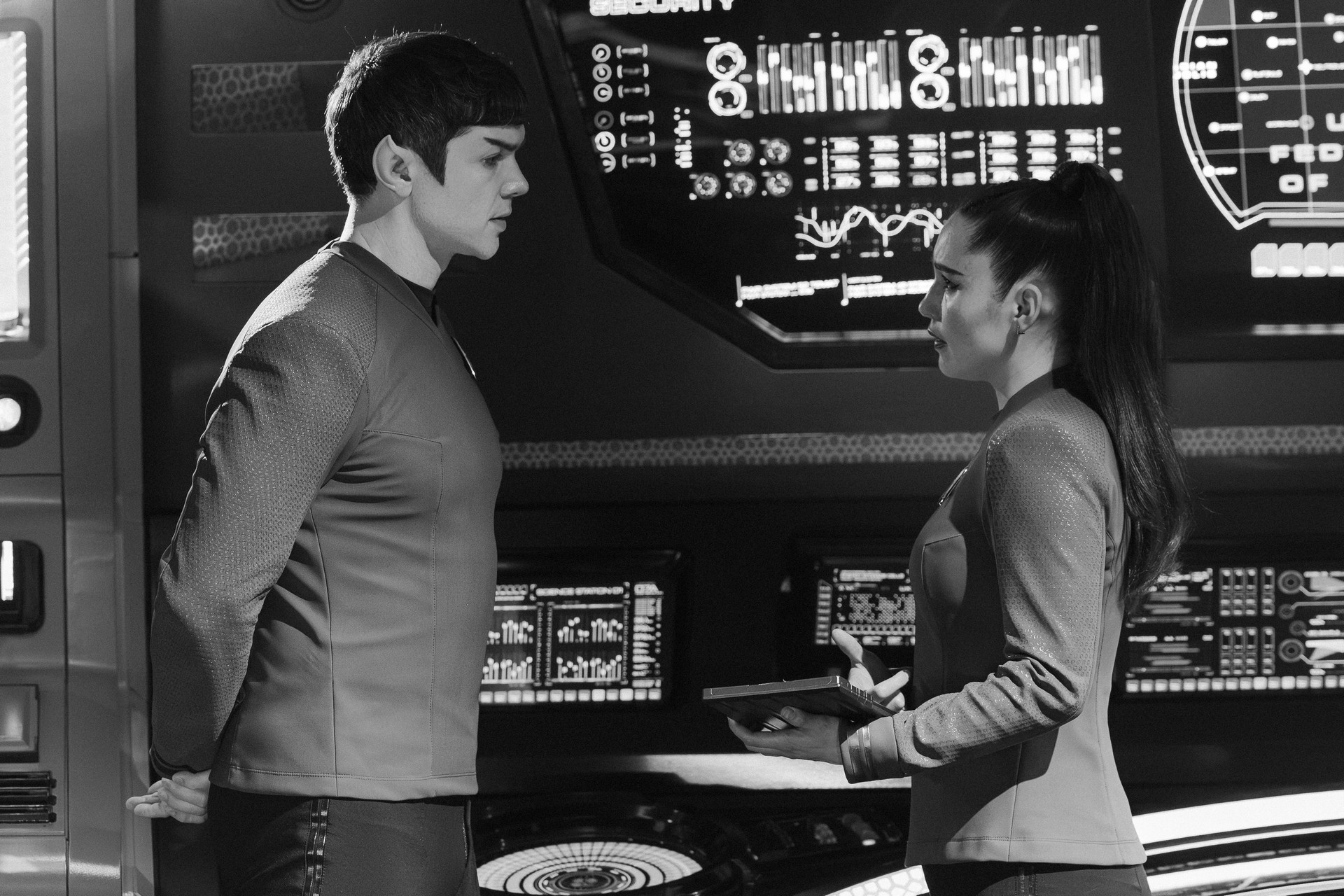
A noun, interrogated. Investigating a tampered data chip, La’an has Cadet A’Sha hunt for hidden patterns in the probe data — the evidence answers the questions it’s asked, one Obtain Information spend at a time. (Star Trek: Strange New Worlds, “A Case of Chiaroscuro.” Photo: Jan Thijs/Paramount+ via TrekMovie)
For Gamemasters: Building a Whodunnit the Nouns Can Solve
Plant nouns generously. In your prep, list the case’s nouns yourself: the victim’s effects, the room, the tool, the record, the witness, the timeline. If a fact matters, it should be attached to something the crew can touch, scan, pull, or question.
Give key facts more than one door. If a single failed roll can dead-end the whole mystery, the design is fragile — the same truth can often surface through a scan, a witness, and a log. Let it.
Complications should add nouns, not remove them. A contaminated sample isn’t a dead end; it’s a new noun. Who had access to the lab?
Keep the dice between the theory and the conclusion. Your players will guess the culprit early — many tables do. That’s fine. A guess isn’t a case. Make them prove it the Starfleet way, noun by noun, and the reveal lands whether they guessed right or not.
The Investigator’s Checklist
Print this. Tape it to the inside of your GM screen, or hand it to your Investigative Lead.
Lead appointed; type of investigation declared (engineering / medical / security / science)
Contact made at the scene; victims, witnesses, suspects named
Case board started: every noun in play, written where all can see
Each noun assigned an owner and a line of inquiry
Scene walked through before anything is touched
Scene captured: wide, midrange, close-up
Rolls made on the nouns; Momentum spent on Obtain Information
Negative results recorded — they narrow the case
Evidence collected with custody noted: what, where found, condition, who holds it
New nouns added to the board as answers arrive
Accusation made only when the board supports it
Two investigators, one case board. Working undercover for Starfleet Intelligence, Worf and Raffi Musiker compare notes until the answers start agreeing with each other — that’s when an accusation becomes a case. (Star Trek: Picard, “Imposters.” Photo: Paramount+ via TrekMovie)
The Short Version
The 2018 procedure tells you how Starfleet works a scene. The nouns tell you where to point it. When your table stalls — and in a good mystery, it probably will, right around the moment the theories start sounding like verdicts — stop, build the board, and ask the only question that matters:
What are the nouns in play here?
Then go investigate them. The evidence is in the rolling.



Leave a Reply