
Welcome to an Era of Play article, detailing other time periods you can set a Star Trek Adventures campaign.
The “Age of Exploration” is what Federation: the First 150 years calls the period prior to the early 2240s. The article is focusing on the period at the very start of the 23rd Century, forty years after the founding of the Federation, and immediately preceding the events of Star Trek the Original Series and Star Trek Discovery.
This era has many of the hallmarks of traditional Star Trek campaigns, and is familiar in terms of tone as well as technology, although the later is still slightly cruder and rudimentary. It’s an ideal time period for a prequel campaign, being familiar and accessible and yet completely open in terms of lore. Even the aforementioned book only references a handful of key events, offering gamemasters the freedom to tell their own stores and make their crews the heroes without having to dodge around canon.
The Early 23rd Century
An ancient Earth proverb is “the enemy of my enemy is my friend.” The truth of this adage was demonstrated in the 2150s, when the Romulan Star Empire made itself the enemy of a number of alien species, prompting them to formalize their alliance. And thus, the United Federation of Planets was created.
With the continued fear of a common enemy, founding the Federation was easy. Maintaining that alliance in the decades to come, without a constant Romulan threat and enduring uncountable problems and complications was harder. And yet, despite these difficulties, the Federation endured. It may even have thrived.
By the first years of the 23rd Century, the Federation had become firmly established. Its policies and laws had been codified, council chambers erected, jurisdictions established, and the economy stabilized. Rogue elements such as pirates had been pushed farther and farther away from trade routes permitting safer travel. With a dozen members and numerous established colonies, the Federation had enough resources to ensure the comfort of its citizens, while advanced technology was more freely shared increasing the quality of life for all. New members joined the Federation every three to four years, happy to take advantage of its prosperity and security while offering their own technology and cultures. Meanwhile, many of the worlds that had been initially reluctant to join the Federation changed their minds upon witnessing the Federation’s respect for member world’s rights and value of other beliefs.
Boldly Going
In the middle decades of the 22nd Century, the fledgling Starfleet was asked to do a much with very little, having few ships and limited resources. Many officers and civilians alike remained concerned about potential alien threats, such as the Klingons and the Romulans, and pushed for Starfleet to become a defensive military force, or even an offensive one conquering potential threats. Peaceful exploration was long championed by Admiral Archer, the Chief of Staff of Starfleet Command, and when Archer was elected to the office of Federation President in 2184, one of his primary goals was to expand Starfleet and create what he coined “a scientific armada”.
Over the subsequent decades, President Archer’s shipbuilding initiative resulted in the creation of several new classes of starship, jointly designed and constructed by engineers from several member worlds. Unlike existing Starfleet vessels, the diverse systems of these ships were designed to work together, with technology such as deflector shields and tractor beams incorporated from the start rather than added via an extensive refit.
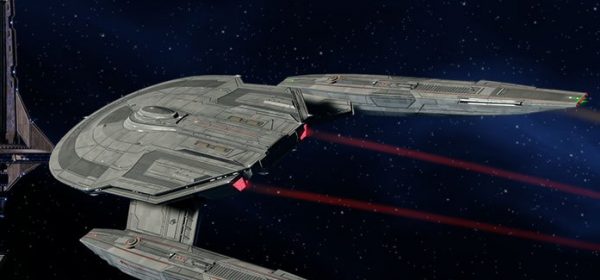
During this period, Starfleet was testing numerous different designs and configurations, experimenting with the number and position of nacelles and the shape of the primary and secondary hull. Among the initial products of this shipbuilding initiative was the Einstein-class scout/explorer and the larger Baton Rouge-class science vessel. Several of these vessels were launched in quick succession, immediately pushing into unknown space that had previously only been charted by unmanned probes or extreme range sensor sweeps. There was even some talk of naming the second Einstein vessel the “Enterprise” in honour of the NX-01, but President Archer request that name not be used, simply saying “it wasn’t time for a new Enterprise“.
Over the next couple decades, the Magee, Cardenas, and Nimitz-class would launch, being followed by similar experimental designs, such as the Malachowski, Hoover, Shepard, and Walker. Only two or three vessels of each design were launched, as Starfleet testing the effectiveness of various designs and configurations. Most of these ships were similar in terms of systems and capabilities, typically varying based on their planned Mission Profile.
These new ships were crewed by an entirely new generation of Starfleet Academy graduates, many of whom had reach maturity as members of the Federation and wholeheartedly embraced its ideals and values. The rookie ensigns of this era might have grown up dreaming about a career in Starfleet and exploring the galaxy for most of their lives. Additionally, for the first time, the majority of Starfleet was comprised of Academy Graduates rather than officers inherited from local defence forces.
Starfleet quickly ran into a logical problem: ships could only travel to deep space for a year or two, but the further they explored the longer it took to return to Federation space to resupply. The solution was to build a series of Deep Space stations nearby allied planets, near the edge of Federation territory. Over time, these stations were upgraded and improved to become Starbases, and their old numerical designation used for new Deep Space stations.
A Peacekeeping and Humanitarian Armada
As the Federation and Starfleet grew, the wholly expected yet largely unpredictable occurred: there was a massive crisis in a Federation system. Historians debate over the first major humanitarian crisis Starfleet faced and whether it was a medical plague or an ecological disaster. By the end of the 22nd Century, there had been several such disasters. As the Federation grew, so did the number of worlds where a crisis could potentially occur, with every member world, colony, or allied system being a potential disaster site. This added a new mission to Starfleet: assist worlds in distress. While all starships were expect to assist with nearby relief efforts, after a few decades it became clear that a number of ships had to be assigned specifically to emergency relief and disaster management missions.
By the start of 23rd Century, the Federation had quadrupled in size exceeding sixteen member worlds with many more allies and outposts, and new worlds were joining at an increased rate. Now very aware of the needs of member worlds, Starfleet designing several new classes of starship explicitly with relief missions in mind.
The exploratory wing of Starfleet added additional humanitarian tasks to Starfleet. As they explored, Starfleet vessels inevitably discovered worlds suffering natural disasters that the inhabitants could not resolve but were within the technological capabilities of the Federation to fix. There were always those in the Federation who questioned “wasting” Federation resources on non-member worlds, but the consensus among the Federation Council was always one of rendering aid when it was requested. However, the question of whether or not to help when aid was not formally requested was a thornier issue.
It did not take long for an exploratory Starfleet vessel to discover a pre-warp civilization on the brink of ecological collapse, a world that could not directly request Federation intervention. In this instance, the Prime Directive forbade interference, especially as the disaster was the result of the actions of the indigenous species. It was argued that Starfleet could attempt to render aid surreptitiously, but the counter-argument was that if Starfleet solved their problems, the inhabitants might not learn from the incident and would lose the opportunity to solve the problem for themselves. Worse, they might even attribute the “miracle” to a supernatural being, affecting their cultural development. In the end, Starfleet Command declined to send aid to planet, but stopped short of ordering the captain of the involved ship to leave the system, effectively leaving the final decision with them. That decision and the results of that mission (both immediately and in the decades that followed) became a lesson in Starfleet Academy ethics courses.
Since then, Starfleet policy continues to be avoiding interference and allowing the natural evolution of cultures, but to render aid in ways that will not interfere. Starships are permitted to assist primitive cultures unaware of the dangers to their planet from natural causes that might lead to extinction level events, but only where the interference of Starfleet will go unnoticed. Captains are strongly discouraged from providing aid in instances where the inhabitants will be aware of the assistance or sudden cessation of the crisis.
Technology
The technology of the late 22nd and early 23rd Century was largely focused on refinement and integration, with the aim of permitting technologies from different worlds to work together seamlessly. More and more frequently, key technologies were associated less with single worlds and instead seen as belonging to Starfleet or the Federation as a whole. As an example, deflector shield technology was no longer considered “Andorian shielding” and simply called “shields”, especially as deflector shield designs now incorporated technology from multiple other worlds.
Armaments
In this era, photonic torpedoes entirely replaced spatial torpedoes and were standard on most vessels. Some exploratory and scout vessels purposely omitted torpedo launchers, as they were deemed military ordnance unsuited to peaceful exploration.
Early in the 23rd Century, work began on higher yield antimatter warheads based on Klingon designs. Unlike photonic torpedoes, these were capable of being fired while at warp velocity, even travelling at FTL speeds for short distances. Officially, these were designated “WC M/AM” ordinance, but quickly became nicknamed “photon torpedoes” due to their photon warhead. Mark I photon torpedoes entered service by 2221, but were still rare: the more rudimentary photonic torpedoes were considered to offer more than enough firepower.
Slowly, photonic torpedoes were phased out, and replaced with the more versatile photon torpedoes. And by the 2230s, Mark IV photon torpedoes had become standard issue on Starfleet vessels. At this time, torpedo launchers were added to existing vessels during scheduled refits. In the mid-2240s, the newly launched Constitution-class became the first Starfleet vessel designed solely for photon torpedoes, and was equipped with the new Mark V torpedoes.
Also during the early decades of the 23rd Century, phaser emitters were in development. These focused energy weapons were planned to replace phase cannons, offering greater firepower and increased versatility with less chance of overloading systems. The first phaser banks were incorporated into existing ships through refits, and produced mixed results. At the time, phaser banks proved to be a heavy drain on reactor power, preventing use of warp engines following a barrage. To offset this power drain, phaser banks were supplied with their own batteries conferring an independent power supply. Following the Klingon War of 2255, phaser banks were made standard on all vessels.
Ships of this era make use of photonic torpedoes without having to spend a Talent. Prior to 2230, a Talent is required for a ship to be armed with photon torpedoes.
Rules for photonic torpedoes, phase cannons, and the Independant Phaser Supply Talent are found in the Command Division Sourcebook.
Replicators
Meals on starships were still commonly produced by either galley chefs or the new food synthesizer, which produced imitation foodstuff from a supply of generic organic matter. Comparable in taste and flavour with 20th Century “fast food” or military MREs (meals, ready-to-eat). In this era, simple industrial replicators were introduced, which were capable capable of creating simple items, such as clothing or tools. However, replicators were only found on starships at the end of this era, as the power and computing requirements initially limited them to starbases.
Campaigns
The story of the preceding era was one of Starfleet finding itself amid the concerns of a fledgling Federation, countering xenophobia while being inundated with the mundane tasks required to build a new political entity. In contrast, the story of the Age of Exploration is one of Starfleet being able to be itself, to finally engage in its primary missions of scientific exploration and spreading out into the galaxy. This is when Starfleet and the Federation begin to fulfil their potential
Much like campaigns set in the familiar eras of the 2150s and 2260s, this period should be familiar. Technology is a little more advanced than it was during Enterprise, but not quite what it was during The Original Series. Ships can’t quite travel as fast or get as far from home, and captains are largely on their own during missions.
As mentioned above, in this era humanitarian missions become more common, with more Federation starships engaging in relief missions. There are not only more worlds that could be experiencing crisis, but previously unsolvable ecological or interstellar problems might suddenly be more easily resolved through newly acquired technology. The severity or negative impact of earthquakes plaguing a Tellarite colony or Rigellian solar flares that can’t be countered locally might be mitigated through technology from other member worlds, prompting Starfleet to dispatch a ship. Meanwhile, worlds suffering from natural disasters might request aid, or Starfleet might send a vessel to render assistance (especially if the world is rich in natural resources and wants them on friendly terms with the Federation).
The middle decades of the 22nd Century had been heavily focused on building infrastructure, such as starbases and subspace communication relays. By this period, many of these installations would begin to require upgrades and repairs in this era. Similarly, many of the initial colonies founded by the Federation would be well established and possibly experiencing growing pains, requiring additional resources and technology. Several might even have gained enough self-sufficiency to apply for full member status in the Federation.
Malachowski-class
Click image for PDF

Click HERE for Black Background PDF
Nimitz-class
Click image for PDF

Click HERE for Black Background PDF


Leave a Reply to Chris ShamCancel reply