
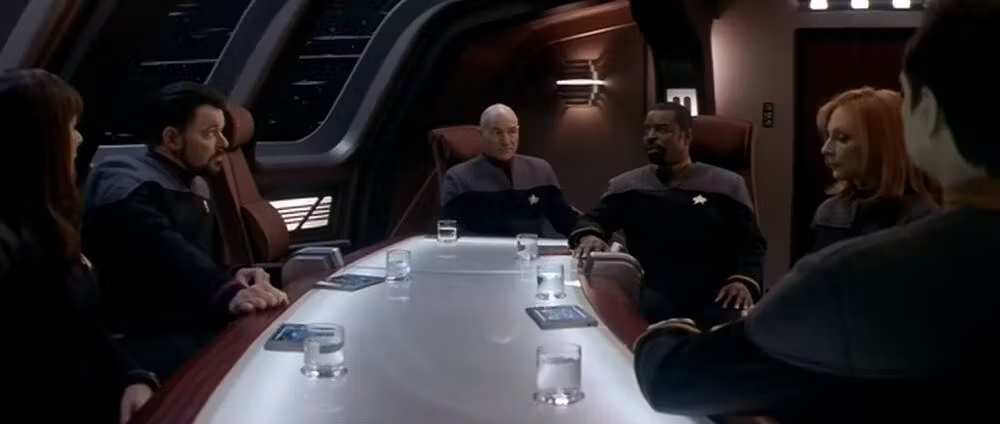
In Star Trek, some of the most memorable moments occur around a conference table, with high-ranking officers pooling their expertise to tackle the crisis of the day. Emulating these pivotal gatherings in your Star Trek Adventures campaign can heighten the atmosphere, prompt team-based problem-solving, and immerse everyone in that distinctly Star Trek mindset.
Begin by describing the setting vividly. Maybe the observation lounge is bathed in flickering emergency lighting, or perhaps an eerie glow from a strange phenomenon outside is casting shifting patterns on the table. Describe the tension in the room, the urgency of the situation, and the mood of the captain. For example:
“The observation lounge hums with quiet tension as the crew gathers. Outside the viewport, the shimmering anomaly casts shifting patterns of light on the polished table. Captain [X] enters, their face calm but their eyes betraying a sense of urgency. ‘All right, let’s hear it. What’s our status?’”

Distributing Key Knowledge
Before the briefing begins, give each senior officer a concise list of facts relevant to their department. They should automatically know these points because of their professional training and position. This prevents them from feeling like they’re guessing blindly. Then, if you want to encourage deeper investigation or more creative solutions, let players roll to uncover extra details or find an edge. I’ve found sending a text to each person, to appear like the findings they have on their PADD is helpful and immersive.
Below are some examples of what those automatic bullet points might look like, along with potential effects of successful rolls:
Science Officer
- Base Information: Detects tetrion radiation that may disrupt subspace systems; a preliminary reading suggests structural anomalies are probable.
- On a Successful Roll: Identifies whether the phenomenon’s origin is natural or artificial, predicts how it might behave in the near future, or notes any unexpected traits.
Chief Engineer
- Base Information: Radiation has taken sensors and defensive systems offline; standard repairs might take eight to twelve hours.
- On a Successful Roll: Spots a shortcut that speeds up repairs, notices hidden system redundancies, or modifies the power flow for extra resilience.
Chief Medical Officer
- Base Information: Tetrion radiation leads to nausea, fatigue, and possible hallucinations; mild symptoms become severe after about twelve hours.
- On a Successful Roll: Discovers a temporary antidote or medical technique to delay the onset of serious symptoms, or finds a way to fortify med bay shielding.
Head of Security/Tactical
- Base Information: Limited sensor function exposes the ship to intrusions; standard yellow alert protocols call for guard postings at key access points.
- On a Successful Roll: Spots a vulnerable hatch or system that might be exploited, or discerns an unusual reading suggesting possible stowaways.
First Officer
- Base Information: Balances the crew’s ideas with the captain’s directives; aware that immediate action is crucial for both safety and mission success.
- On a Successful Roll: Negotiates effectively between conflicting plans, reveals a new way to merge multiple goals, or offers an insight that keeps everyone on track.
Structure the Conversation
Give each officer an opportunity to speak, beginning with the captain or first officer inviting reports in a clear order. For instance:
Captain/First Officer Introduction
“We’re contending with a mysterious anomaly that’s taken out critical systems. Let’s get everyone’s status reports and map out our next steps.”
Department Summaries
Each player shares what their character knows automatically, plus any new findings from rolls. This ensures the entire group stays informed and has the chance to contribute a unique angle.
Open Discussion
After every department weighs in, let the team ask follow-up questions and debate priority actions. The GM can throw in curveballs if the conversation stalls or strays too far: perhaps a dramatic surge in radiation or an incoming hail from an unknown source.
Decision and Orders
The captain chooses a course of action based on the group’s input. The first officer might delegate tasks to specific departments, ensuring each has something tangible to accomplish.
Steering the Narrative with Plot Hooks
A briefing can quickly go off the rails if players propose unexpected solutions or get stuck on minor details. As GM, you can subtly steer the scene by:
Asking Questions as NPCs:
If players overlook critical details, introduce an NPC (e.g., a junior officer) who raises the issue.
“Doctor, how long can the crew withstand this radiation if repairs are delayed?”
Adding Dynamic Challenges:
If the briefing gets bogged down, introduce a time-sensitive update.
“Captain, the anomaly’s radiation is spiking. Long-range scans suggest it may destabilize in 8 hours.”
Revealing Unexpected Risks:
Drop a new complication to refocus the team.
“The damaged systems have also taken down our external communications. We’re effectively cut off.”

Leveraging Rolls and Complications
Skill checks can add stakes to the dialogue. A high success might give your group valuable intel, while a near miss could lead them down the wrong path—or draw out the scenario. Don’t be afraid to use Threat to represent growing danger. If things are taking too long or if some new external factor arises, adding a complication can inject urgency:
“As you finalize your plan, an automated console alert reports an unexpected surge in the anomaly’s power readings. You only have six hours now—two hours fewer than anticipated.”
Giving the Captain Authority
In canonical Star Trek, the captain always has the last word. If a player is roleplaying the captain, prompt them to weigh options carefully, synthesizing ideas from their officers. This leadership element can be enormously rewarding for players who enjoy guiding the narrative. For those groups who have an NPC as Captain, let the player group function as advisors who shape the situation with their discoveries and expertise.
Wrapping Up
Senior staff briefings are a signature element of Star Trek, offering not just information exchange but also an opportunity for characters to display their skills, personalities, and sense of teamwork. Encourage your group to indulge in some trademark Star Trek flair—scientific jargon, strong ethical stances, and flashes of humor—and watch as your campaign comes alive with the same vibrant energy fans love in the shows.
Good luck, and happy briefing!
Leave a Reply