

IN CONVERSATION WITH BLENDER ARTIST – TEKKNONERD
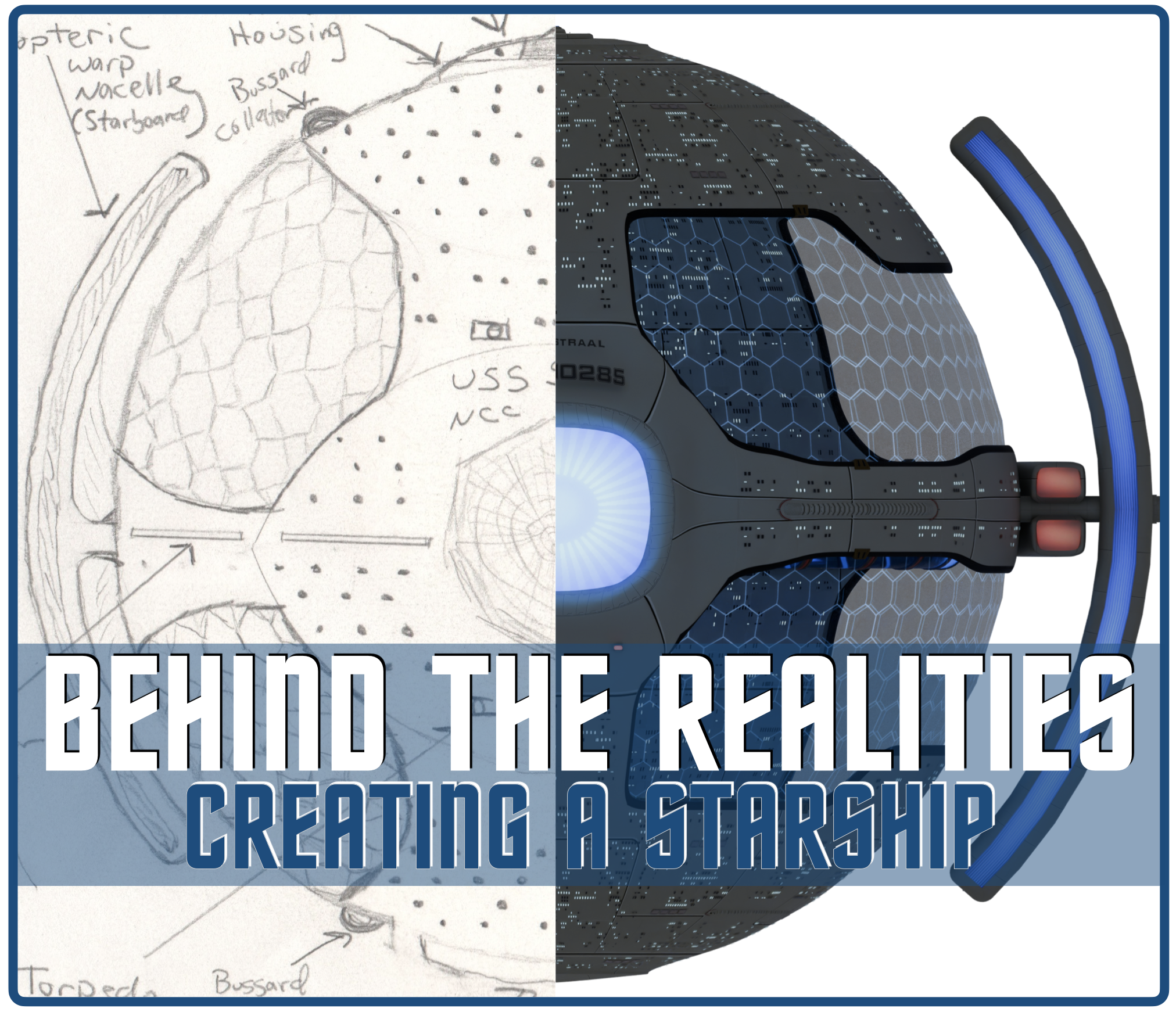
Hello and welcome to a special behind-the-scenes edition of the Realities of Possibility series. In this edition, I share my interview with Digital Blender Artist TEKKNONERD, who modeled and animated my ship concept for the Stamets-class space frame featured in the Realities of Possibility: Sporefleet article.
If you are someone who wants to see their starship ideas come to life, either by working with a digital modeler, or by learning how to do it on your own, or just curious about the experience, I hope you will glean some useful information from our conversation.
Before diving into our interview, here are some examples of Tekkno’s animation work.

In conversation with Tekknonerd…
ARWYN: Hi Tekkno. Thanks for taking some time to talk about your design work and process. It was fantastic to get to work with you on the Stamets project, and I’m fascinated by anyone that can take someone’s far-out, fan boy ideas and basic sketches (that would be me) and transform them into living, breathing 3D animation. First off, how long have you been creating in Blender, and what motivated you to try your hand at it?
TEKKNONERD: Firstly, you’re welcome, it was a fun and interesting project to work on and I really enjoyed working with you on it.
I’ve been working in Blender since around about mid-2020, and the year in question ought to tell you why I started getting into it! But although the pandemic and lockdowns did have something to do with why I finally picked it up, I’ve always had an interest in 3D modeling and animation. I did some film editing during my college years as part of one of my courses in media studies and got to mess around with Premiere. From there, I started making some very basic videos for my RPG groups around the mid-2000s (nothing more exciting than an opening crawl to some music, and VERY basic animations), and that led into some basic 3D animations. After that particular group stopped playing I didn’t really pick up anything to do with video or 3D software again until the pandemic.
A: What was your first project? How did it go?
T: My first Blender project was ‘The Donut,’ a long-form tutorial series that most people who pick up the software go through. I don’t really think that counts though, so my first actual ‘I want to do this’ project was a Star Trek corridor, based on the Galaxy-classes. It was – and is – rough as hell, but it let me sit during the time I was off work and pretend to be doing something, and those original renders still hold a soft-spot for me because of it. It allowed me to get to grips with the program proper, and start really understanding how things like texturing, modifiers, and lighting all worked.
From there I made a Borg alcove as a further test of what I’d learned, and probably the thing I learned best from that project (at least in hindsight) is that you don’t need to work so hard on details that no-one is actually going to see in the final render and to focus attention to where people will actually be looking.
A: Ah, yes. The Donut. I have seen people share them with pride on Discord servers for different gaming communities. Speaking of gaming communities, we met through a mutual Game Master for Star Trek Adventures, and you have made some truly inspiring and beautiful intro sequences for their games. How much of a leap was it to go from static projects to full-blown video animations, and what’s involved in that process?
T: Well, I started working on static environments for that Game Master before we progressed into the opening sequence animations. I’d already tried my hand at this before they’d asked me to look into it, so I had a rough idea of what I was doing, but I was a little rusty so needed some time to not only get back into animating things smoothly, but also working in the music, titles, sound effects, et cetera to make a proper opening. Blender, being an all-in-one program with some video editing/ sequencing tools, made that process a little easier.
I suppose the biggest thing I’ve learned that I wish I’d known is the phrase ‘perfect is the enemy of good.’
A: You have made several of these intro sequence videos now. How has your process changed and what are some things you’ve learned that you wish you knew when you started?
T: Yeah, my process has changed considerably from when I first started. A lot of that was working out how Blender actually worked, how to make things look good, what lighting is needed to make things look realistic, but also without drowning out the image or having it so dark you can’t see anything. There was a lot of trial and error. I suppose the biggest thing I’ve learned that I wish I’d known is the phrase ‘perfect is the enemy of good’ – there’s a lot in those earlier videos I know I could have done better now, or which at the time I spent far too much time on and then are barely seen. But probably the biggest lesson was just learning how to make a Star Trek ship move like a Star Trek ship. They have a very distinctive, slow and majestic movement that I’m still trying to emulate now, but I think I’m getting closer to!
A: I enjoy your video animations a great deal, but one of my personal favorites of your projects was actually the static art you did of a starship galley and mess… right down to the custom flatware! Which projects or work that you have done are your personal favorites or particular sources of satisfaction?
T: It’s a bit of a cop-out answer, but I’m proud of all of my work for different reasons. Almost every video I make has me learning some new technique or process, helping me to elevate it from what I’ve done before. Sometimes that’s an obvious ‘on-screen’ effect like an animation technique, or new portal, or phasers or whatever, and sometimes it’s something behind-the-scenes like the settings used for rendering, but in whatever case, I’m usually pretty proud at having figured out something!
Seeing the player, chat, or commissioner’s responses to it is always gratifying as well, but some of the things I like best about those introductory videos are the little easter eggs I manage to sneak in. Most get identified pretty quickly, but adding them in is just a little way to have fun with what I’m doing.
I’m particularly proud of some of the more recent work I’ve done in replicating the Star Trek Online corridors, making them more to scale with the people who would be walking them, adding modular sections to them so I can customize a scene quickly and easily. It’s been a fun and diverting side-project and I’ve really liked the results.
I am also quite fond of that flatware though. I would quite like to have it in my own dining room!
A: On behalf of all of us that have played Star Trek Online and looked at those massive corridors with a healthy dose of side-eye, I thank you!
Okay, let’s talk a little bit more about the Stamets-class. You had mentioned to me that you wanted to take it on because you wanted to “stretch yourself.” What was it about the project brief that you thought would challenge you? Now that the project is complete, were you correct?
T: I’ve only built out a couple of starship models in the past, and usually from a single reference image, but mostly they were pretty ‘typical’ Star Trek ships. The Stamets-class designs you sent me were interesting. There were still some of the Trek design elements in there (nacelles, bussard collectors, hangar-bays and phaser-strips, et cetera) but the overall scale and shape of the ship was considerably different. In some ways it looked like it should be incredibly simple (it’s basically a sphere, after all), but the attention to detail in the design brief was what made it interesting. Having a spore-forest, an oxygen farm/ recreation area, and the aquatic ring / deck, all made the ship interesting and appealing.
In terms of the challenge, yeah, I’d say I was correct! There were a lot of revisions, remodeling, and considerably more issues with UV unwrapping than I had expected. Most of which became all the more glaringly obvious during animation, when suddenly you were getting a lot closer to the model than I’d anticipated. That basically meant rebuilding the hull completely for what I think was the fourth time in order to make sure the level of detail was good enough to be seen close up, even if only for a few seconds.

An early Blender wire frame of the interior of the Stamets-class and a test of its three-ring rotating displacement engine.
A: Your attention to detail certainly came through in the video, even down to the running lights. Speaking of details, when I first talked to you about modeling the ship, I sent you a lot of sketches and ideas about the vision I had for it. In hindsight, I should have asked you first about your process and what you needed. I’d like to correct that oversight and ask you now: When someone is interested in commissioning you for a modeling project, what are some things you need most prior to creating a piece and how can the submitter best prepare ahead of time so things go smoothly?
T: That’s a tough one, because it can vary from case-to-case. In some commissions, what is being requested is pretty clear, and most people provide me with similar reference sketches to your own to show me roughly what they want. Really, the most important thing is those references. While I can just go nuts and create a Star Trek bridge from scratch, I have no idea if it will match what the customer wants without being given references. Do they want TNG era, or TOS-movie era displays for example? Should the design reflect original TOS designs with big, bloopy push buttons, or digital SNW-era displays? What kind of Captain’s chair do they want, and should it be alone, or side-by-side with the First Officer or other specialist chairs? I can riff on a theme, but being given references and even a really simple MS Paint plan of the scene helps immensely with getting the customer what they actually wanted.
A: I am glad to hear my submissions were in line with what you wanted. But, all this talk of bridges is making me wonder why I never approached you about a bridge! I am mostly kidding. I am incredibly happy with what I have.
Back to my question sheet: One of the biggest challenges for me during our collaboration was trying to figure out the bussard collectors. What were a couple of things you spent the most time trying to ‘get right’ on the Stamets-class, and what were you the most pleased with after the fact? Any surprises?
T: The bussard collectors were a challenge, as was fitting them cleanly to the nacelles and ultimately the hull. But probably the biggest challenge, and the thing I spent the most time on, was the hull itself. Getting the right shapes, the correct level of detail, and then making the textures work as intended so hull plates weren’t suddenly warping along curved lines was a real challenge. I’m pretty pleased with how it finally came out.
I think the scale of the vessel was the biggest surprise, getting deck windows to be consistent with other vessels, and having the visible interiors scale correctly with everything else was a big challenge – especially where the details needed to be seen. I think I probably cheated in a few places with it, but overall I think it works!
A: I think so too. When I approached you, it was for static art, but then it transitioned into that wonderful animation you made. Even though I floated the idea of a shuttle being transferred from one ship to another, you ran with it and made several clever story-boarding decisions. How did you plan and visualize that sequence, and come up with the idea of the gradual pan around the Straal? How difficult was it to then go in and edit it again to do the aquatic operations flyby I requested after seeing the first video? And… How the heck did you get that whale to swim so elegantly?
T: One of the best things about Blender is that you can go in and adjust something on the fly, and then get the new version play out in real time. That’s not to say that altering one thing just makes everything work immediately, because it doesn’t. But you can shift things around and see if you like it better one way or the other with relative ease before you start adjusting everything else.
You mentioned originally wanting to see the shuttle depart the Galaxy-class escort, and the ship to jump, and so that gave me a pretty good starting point for what needed to be in the scene, and the A > B on how the animation should play. The original version was…fine. I think you were right to ask for the aquatic-ops flyby. It really adds something to the scene and lets you see some of the scale more clearly.
As for making the whale swim elegantly? Well, I’ll say the motion in the final shot probably helps a lot with that. I did look at videos of how whales typically swim for reference, but a lot of that doesn’t really show in the few seconds it is on-screen for – or maybe it does and that’s what you’re seeing and commenting on. Ultimately, you’re happy, so I’m happy!
A: Oh I was HAPPY… there may even have been a gasp of delight at some point. Is there anything else about the project you’d like to comment on that I didn’t ask about here?
T: I think it’s a bit of a shame some of the other features present on the model aren’t clear and present in the animation – the promenade along the top decks, or the underside docking port, for example. But they can be seen in the final renders, so I’m pretty happy.
Overall, I think the biggest thing I’d like to comment on most is your patience as I worked on it, and your enthusiasm for the project. It’s been really fun working with you on this, and adjusting it based on your feedback and reactions.
The best time to start was yesterday, and the second best time is now!
A: Are you kidding? I am profoundly grateful to have had the benefit of your expertise and experience on the project. And, I agree, it was a lot of fun working with you as well. Speaking of your expertise, what advice would you give anyone reading this who is interested in trying out digital design and modeling?
T: Just do it, really. Blender is a free program (although you should donate to them if you can!) and very easy to pick up and learn – be it complex 3D animations for films, or low-poly characters, environments or animations for you and your friend’s DnD group – just jump in and try it out. I’m hardly an expert on it myself and am always learning something new and interesting – and some of the things people do with geometry nodes is straight up magic as far as I’m concerned! – so if it appeals to you at all, just get stuck in! The best time to start was yesterday, and the second best time is now!
I would probably say don’t do The Donut tutorials – despite that being where I started – but instead have a search on YouTube for other tutorials that get you doing what you want to do the fastest. Seeing the first 3D model that you wanted to build take shape is so immediately gratifying, even if learning how to do it can be frustrating at first!
A: Great advice. And.. finally, let’s end things on a fun note and learn some Trek-related facts about you. What was your first introduction to Star Trek, and why did it connect with you?
T: Kind of hard to answer. While I’m not old enough to have seen Star Trek when it first aired, I definitely had a bunch of episodes recorded onto VHS which I would watch when I was younger. For the life of me though I can’t remember which of them were on those tapes except for “The Man Trap” and “Charlie X”… those I remember pretty clearly. I’m pretty sure I watched one or two of the films on VHS as well. I have very clear recollections of Star Trek V: The Final Frontier…but I only really got hooked on Trek when Star Trek: Voyager started showing in the evenings on BBC 2. I remember watching “The Caretaker” and just falling in love with the Intrepid-class, and of course the Voyager crew. Even though I don’t necessarily look back at Voyager and think it’s the best example of Trek – or necessarily always of television – I have a definite soft spot for it.
A: Interesting. I have a soft spot for Star Trek: Voyager as well. Who is your favorite Star Trek character? What is it about them that makes them your favorite?
T: Put a phaser to my head and I’m not even sure what I’d say in answer to this. I couldn’t even tell you who my favorite character is between each series, let alone out of the whole franchise. I love all of them for such different reasons. Is that answer a massive cop-out? Yes, but it’s literally the only one I can give.
A: Oh my gosh, no one is putting a phaser to anyone’s head…even figuratively. [laughs] I’m not going to force you to choose!
I think I know the answer to this last one, but I’ll ask it anyway: What is your favorite Star Trek starship, and why is it the Sovereign? Any other favorites?
T: Yeah, look. I love the Sovereign. I think it has such a gorgeous design, maintaining some of the elements of the prior Enterprises, but just making it look so sleek and sexy, as the leading lady in a new series of films. The first time you see it in First Contact, gliding slowly out of a nebula and swinging towards camera, with the TNG theme playing in the background? I love it. Every element of it looks like it’s there on purpose and like it genuinely was designed as a character in its own right. I suppose that might also be the answer to the question above?
I suppose some of that design philosophy also makes it my joint-second choice, which is probably the Defiant-class and Intrepid-class. There’s something about the way the Defiant was designed to be this very clear instrument of war – low-profile, armed to the teeth, with a warp-core so overpowered that literally shakes the entire thing apart – but still retains those classic Trek design aesthetics. And the Intrepid just looks so aerodynamic and sleek that it just reads as ‘speedy science-ship’ and you don’t even question it. Plus, variable-position warp nacelles. Very cool!
I think the nineties was honestly the peak of Star Trek ship design.
Honorable mentions to the Luna-class and Odyssey-class though!
A: All good choices, especially the Luna-class. I love that ship.
Thank you again for taking the time to give folks an idea of some of the work that goes on behind-the-scenes to create digital models. Where can people find you online, and what is the best way to get in contact with you?
T: I’m on BlueSky as my primary social media, but you can also find me in some other places. Best thing to do if you want to get in touch is to message me on there, or you can get directly to my commission form here:
I’m always happy to get a message, even if just to discuss what you want, so feel free to reach out.
A huge thank you to Tekknonerd for taking the time to talk to me, and thanks to all of you for sticking around.
Until next time!

Leave a Reply