
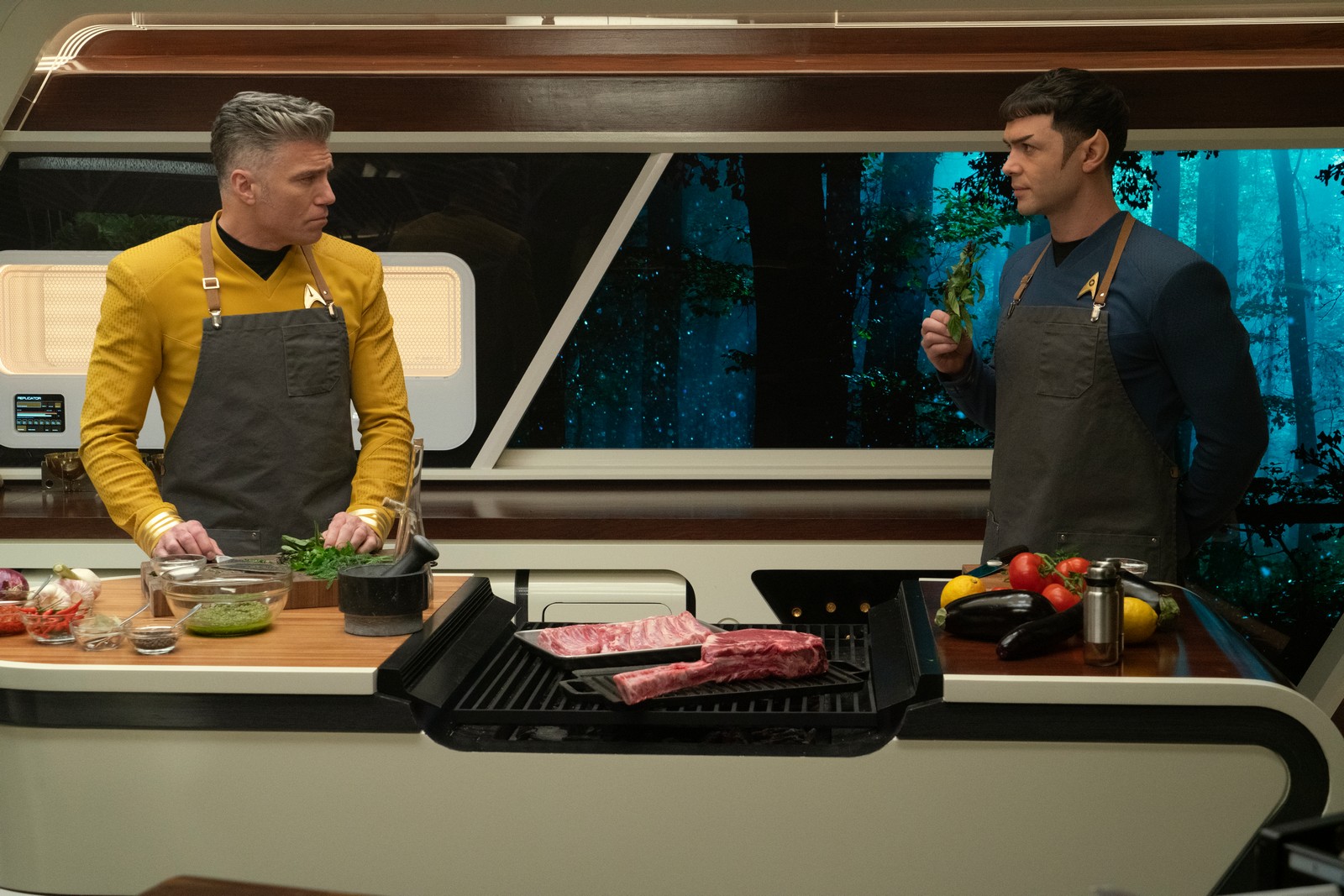
Ask a room of gamemasters how they open a scene and many of them will start reading you a spec sheet. The chamber is twenty meters across. The alien vessel has a crew of forty and a warp core rated for such-and-such. All of it accurate. None of it alive. Your players nod politely, and what they’re actually doing is waiting for the part where something happens to them.
Here’s something new GMs don’t hear often enough: most players don’t experience your game through numbers, at least not first. They experience it the way they experience everything else in their lives — through their senses. The moment you describe what a place smells like, you’ve done more for immersion than a page of stats ever will. I wrote a whole piece about this in my game master chapter for the Lower Decks Campaign Guide, and Jim and I talked it through on Continuing Conversations. The rule is simple enough to fit on an index card, and I reach for it just about every time I sit down to write a scene:
Pick three of your five senses. Try it on every scene, and see what happens. Assign these qualities as Traits.
Here’s how I put it on the show: “I pick three of my five senses in order to write a scene at any time. So I’m like, okay, this is kind of boring. So I’m going to pick maybe this time I’ll pick smell, touch and sight, and I’m going to just add some details to this scene using just three of those senses, and people — it just expands from there.”
Three. Not five, and probably not ten. Three is a discipline, and the discipline is a big part of the point. When you force yourself to choose, you stop dumping an inventory on your players and start composing. A scene with three sharp sensory details feels inhabited. A scene with twelve feels like a real estate listing.
Let me show you what this does, using this example: You walk through an open door. A warm breeze greets you. There’s flower petals everywhere. There’s a sound of classical music, and you see some wine set on the table — but there is a strong rank smell of feces. (A gross Trait for the scene, but a fun and possibly funny one too.)
Right away, everything changes in that scene.
Notice what happened at your table just now, because it happens a lot. The breeze, the petals, the music, the wine — your players built a little paradise in their heads, comfortable, safe, maybe romantic. Then one detail landed wrong, and the paradise cracked. “And people now have questions, right? They’re like, what the heck is the source of that?” That question is close to the most valuable currency a gamemaster has. Your players are no longer waiting for the scene to happen to them. They’re investigating. They’re leaning in. You didn’t roll a single die or quote a single stat, and the scene is already a story.
That’s the engine: two senses to build the world, one sense to break it. Or three to build it and save the break for later. The combination matters less than the habit. (This is not a hard and fast rule. Just providing some guidance.)

A few things I’ve learned running it this way:
Sight is the default, so try not to spend all your picks on it. Most of us describe what things look like without even thinking about it. The other four senses are where a lot of the heavy lifting hides. The hum of a healthy warp core through the deck plates. The recycled-air tang of a ship that’s been sealed too long. The specific silence of a room where the ambient noise just stopped — many Star Trek fans will tell you that silence means trouble before a single word is spoken.
Smell might be the most underused sense at the table, and maybe the most powerful. It tends to go straight past the analytical brain. A Klingon mess hall, a Ferengi market, a Jefferies tube full of hot circuitry — one smell tells your players where they are faster than a paragraph of geography. It’s also the best sense for wrongness, as the flower petals demonstrate. Beautiful scene, terrible smell, instant mystery.

Sound can set the emotional temperature. Quark’s at full roar versus Quark’s after closing. A captain’s mess with quiet music versus a mess where nobody’s talking. You don’t need to describe the whole room if your players can hear what kind of room it is.

Touch can make it personal. Cold bulkhead. Warm mug. The vibration in the floor when the ship goes to warp. Touch is the sense your players’ characters can’t switch off, and it’s the fastest way to make a player feel like their character has a body instead of a character sheet.
And this isn’t just a table trick — it’s a writing trick, and it scales all the way up. When you’re writing a novel or a short story, engage at least one sense every couple of pages. What are the characters experiencing? That’s what pulls a reader in, and it’s the same muscle. Whether you’re narrating a scene for four players on a Friday night or writing a mission brief somebody across the world is going to run, the question stays pretty much the same: what does it smell like in there, what does it sound like, what does it feel like?
Star Trek itself seems to have understood this for a long time. The shows are full of scenes you remember sensorially before you remember them narratively — the ambient life of Ten Forward, the clatter and commerce of the Promenade, a quiet moment on an observation deck with nothing but stars and ship noise. The franchise’s worlds feel real because they were built to be experienced, not just observed. Your game deserves the same courtesy.

So here’s your homework, and it’s small. Next session, pick one scene — just one — and open it with three senses instead of a description. Two to build the world. One, when you’re ready, to crack it open. Watch what your players do. Chances are they’ll start asking questions you didn’t plant, investigating corners you didn’t detail, caring about a room you invented forty seconds ago.
That’s not a stat block doing that. That’s three senses, chosen on purpose. It pays off big time.
Leave a Reply