
Episode 2×4 “Biological Clock”
By Fred Love
From These Are the Voyages
Airdate: May 18, 2024
“With complete disregard for his personal safety…”
With a lot of pride and gratitude, Cmdr. Athytti sh’Shaine (Andorian F, Executive Officer) read out the citations for Bagheera (Caitian M, Security Officer) for his actions on Kirlos during the Ariantu Crisis, pinning on his medal and new rank. The big cat was now a Lieutenant (j.g.), and the Starfleet Commendation for Conspicuous Gallantry entered in his personnel record. Cmdr. Thalon Quilar (Andorian M, Chief of Security) had him moved up to the Bravo Shift tactical position on the bridge rotation.
“…the highest credit upon himself, the USS Lexington, and the Starfleet service.”
As the ceremony broke up, it was time for Alpha Shift to go on duty, and the senior staff made their way from the observation lounge to the bridge. Following first contact with the Krilian hive mind, the USS Lexington (NCC-1709, Constitution class, Scientific and Survey Operations) had resumed her mission conducting a long-range survey mission far beyond Federation space in the Beta Quadrant.
As Alpha Shift arrived on the bridge, Cmdr. Sabin Trall (unjoined Trill M, Chief Science Officer) registered an anomaly on sensors: tetryon bursts originating from the planet Optera IV. Since tetryons normally occur only in subspace, this was unusual, so Capt. Mary Birdsong (human F, Commanding Officer) had the Lexington divert course to the Optera system. During the voyage, Sabin collaborated with Cmdr. Ter’Rec (Tellarite M, Chief Engineer) to modify the Lexington’s advanced sensor suites to track tetryon particles in both subspace and normal space, overcoming the usual difficulty of tracking tetryons with any accuracy. This was made easier due to the crew’s experience with the tetryon wave from Abassa VII’s ocean life-form the previous year. As the Lexington arrived in orbit of Optera IV, the modified sensors showed that the tetryon bursts originated at numerous sites around the planet, most of them beneath the surface. The bursts occurred in repeated patterns, suggesting a call-and-response of intelligent life-forms communicating.
Sabin looked up the library computer entry for Optera IV. The system had never before been visited by a manned starship of the Federation or any ally. An unmanned probe from UESPA had charted the system 40 years earlier but found no evidence of advanced civilizations. The sensor technologies of the 2230s were considerably less precise than the Lexington’s cutting-edge sensors in 2271, but if the tetryon bursts had been occurring at the time, the probe still should have picked up an anomaly even if it could not get any detailed scans, so it was reasonable to assume that whatever life-forms were using the tetryons to communicate had arrived within the last 40 years. The planet was Class M, hosting a variety of climate zones and climate types, with a breathable nitrogen-oxygen atmosphere. There were no cities, no infrastructure, and no sign of industrial activity. The planet’s core, impenetrable to the probe’s sensors, now lit up the Lexington’s science console with a remarkable reading: the core was in an entirely liquid state creating regular subspace inversions, allowing the stable formation of solanagen throughout the planet’s crust, particularly in a network of subterranean tunnels present almost every continent. Solanagen, like tetryons, normally occurred only in subspace.
The sensors also picked up four points of interest, which the senior staff evaluated for away team investigation: a mysterious power signature in an uninhabited desert; a high concentration of tetryon emissions inside a subterranean cavern; smaller, localized tetryon emissions around a remote mountain peak; and most alarmingly, a blind spot near the planet’s core reflecting sensor scans back to their point of origin.
“I have a very bad feeling about this,” Sabin said of the blind spot almost immediately. The crew suspected that any danger in the system was likely lurking inside that sensor blind spot and would need to be accessed, but beaming inside would be impossible without more information. Therefore, they decided to investigate the power source in the desert first, with an eye toward finding a way to access the core and penetrate its sensor interference.
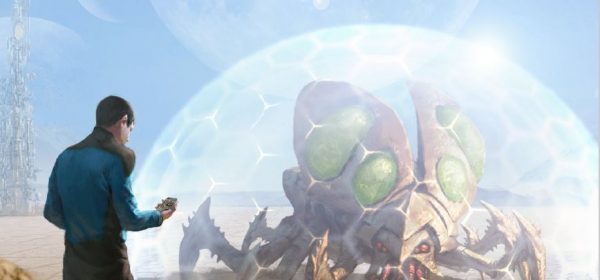
Sabin, Ter’Rec, and Bagheera beamed down to the desert site, near a tower with some sort of electronic instruments protruding from it; Ter’Rec identified it as a shield generator. They also saw two hoverbike-sized insectoid life-forms, one of whom was trapped inside of a force field. Sabin found the creatures’ appearance horrifying, while Ter’Rec thought they were kind of cute. The two were clearly trying to communicate with one another, with tetryon bursts back and forth. Sabin’s tricorder monitored those bursts, as well as noting that the force field extended under the surface as well as above it, preventing the creature from escaping by burrowing underneath. Sabin comically attempted to use body language to communicate with them; they paid attention to him but obviously did not understand. Ter’Rec had the Lexington beam down a portable phase coil resonator, and he and Bagheera wired it to Sabin’s communicator with its universal translator and two tricorders to monitor the tetryon emissions. After monitoring the tetryon emissions for several interactions, the universal translator was able to decipher the language; the phase coil resonator could then emit tetryons to respond. The Opterans (as the creatures called themselves) could only manage to get very basic messages through this crude system, which boiled down to “help us!” With a combinator of tetryon bursts and body language, Ter’Rec indicated that they were going to overload the force field and free the captive Opteran, gesturing for them to stand back. Ter’Rec and Bagheera took aim with their phasers, careful to avoid the Opteran, and blasted the force field into oblivion, overloading the shield generator in the process, as smoke began rising from the tower.
The away team was able to engage in a somewhat longer conversation with the Opterans, with the universal translator getting better at handling complex thoughts the more language it was exposed to. Grateful for the rescue, the Opterans explained that their species was emerging from the core as part of a life cycle that lasts around 74 Earth years. The Opteran species originally came to normal space through a subspace tear in the planet’s core, which is now sealed by some sort of energy barrier so they cannot return. The ancestors also spoke of “hunters” scouring the planet and taking away Opterans, although these two individuals had never encountered one nor knew of anyone who had. The Opterans also requested that the crew help them by investigating a piece of strange alien equipment in one of the subterranean tunnels, among a dense concentration of solanogen crystals. The Opteran people had long since abandoned that tunnel, but these individuals were able to provide the coordinates for the crew to relay to the Lexington.
At this point, the two Opterans underwent some sort of metamorphosis, which Sabin monitored with his tricorder and determined was a natural part of their life cycle, shedding their exoskeletons and flying away. Left alone to consider the legend of the hunters, the away team walked to the generator tower and examined its burnt-out equipment. Ter’Rec had no difficulty determining that this was garden-variety force field equipment built by a civilization near or somewhat beyond the Federation’s technology level as of 2271. The equipment and controls were obviously designed to be operated by humanoid physiology (two arms, two legs), and so could not have been built by Opterans, and pointed to the intervention of another alien species. The hair on the back of Sabin’s neck stood up as he suspected this second culture was up to no good.
The away team returned to the Lexington, which had still encountered no success penetrating the shielding around the planet’s core with sensor scans. However, science team working in the geology lab was able to pinpoint the location of the alien hardware in the subterranean tunnel, and reported that although there was nothing weird about the tunnel itself, some sort of foreign object was lodged in the ceiling. Ter’Rec, Sabin, and Bagheera beamed into the tunnel, finding themselves in a dark, creepy chamber and needing to climb halfway up the cave wall to reach a wrecked vehicle of some sort. It appeared to have a drill nose and was built for excavation rather than space travel. Its canopy was blown open and its two tandem seats were vacant, not a trace of its occupants left behind as Sabin’s wrist light swept across it. Ter’Rec mentioned how much this reminded him of the old Earth movie Alien when the dead space jockey and his crashed vehicle were discovered, a disquieting comparison that made Sabin’s stomach turn.
Ter’Rec managed to pipe power from his tricorder into the onboard computer, accessing the log entries left behind by the alien crew before they abandoned their vehicle. Their species called themselves Kavians, and these two were members of an organization calling itself the Kavian Expeditionary Force. Their mission was to travel to the planet’s core to strengthen the power connections between four Opterans being held captive and the force field equipment keeping the subspace tear in the core from reopening. Essentially, the Kavians sealed the subspace tear to prevent the Opteran species from returning to subspace, and was harvesting them every 74 years as living power sources for their civilization’s energy needs. Ter’Rec realized what was going on, he exclaimed, “Oh, we’re shutting this down!” while Sabin stated that The Matrix would be a more appropriate movie comparison, although the Opteran captives being used as living batteries were probably not experiencing anything as entertaining as a simulation of 1990s Earth.
Athytti contacted the away team, alerting them that an unidentified alien ship was entering the system, and the Lexington needed to go to yellow alert and raise shields. If they wanted to return, it would have to be now. They did, and beamed aboard the Lexington at once.
In the time it took Sabin to walk from the transporter room to the bridge, all hell broke loose.
The alien ship was ugly and massive, like something out of a 1970s sci-fi cover. Sensors showed Sabin she was emitting absurdly high levels of tetryons from her power systems, with technology a good 50 to 100 years more advanced than the Federation’s. IFF translated her name as K.E.S. Ko’Falgrin. Sabin was at least able to scan her and identify a few structural weaknesses–she was not a warship by design. She briefly hailed the Lexington, her skipper Sharama Kaladok declaring Optera IV the property of the Kavia and ordered Lexington to leave the system immediately. Two further hails by Birdsong met with no response, and the Ko’Falgrin launched twelve armed assault shuttles toward the planet, each packed with six Kavian soldiers. Birdsong called red alert.
Thalon inserted Bagheera at the tactical station, leaving the bridge for the armory to get strapped up for ground combat. There was no way he would let his troops go into a ground war without a senior officer alongside them. All three of Lexington’s shuttles were brought to flight readiness, with a squad of security personnel aboard each, packing phaser rifles and personal shield generators.
However, before launch, the senior staff quickly reconsidered their options. Rather than extend the engagement by engaging in dispersed ground battles, in which Thalon’s troops would be outnumbered and the Opterans vulnerable, Sabin suggested that the Lexington could move into a blocking position, and shoot down the Kavian assault shuttles if they tried to bypass the ship. However, Ter’Rec and Athytti disagreed, since any delay would give the Kavians time to abduct Opterans and escape back aboard the Ko’Falgrin. Ter’Rec argued that they were dealing with middle management here, not the CEO, and convincing Kaladok to back down would only delay the inevitable. So instead, Birdsong decided on the direct approach to end the engagement as quickly as possible by blowing the enemy to pieces.
Lt. Iban (Risian M, Flight Controller) put the Lexington into an attack pattern, while Ter’Rec diverted reactor power to the phasers for maximum damage output. Birdsong directed Bagheera to concentrate on taking out the Ko’Falgrin’s shields, gambling that with her defenses down, Captain Kaladok would not risk losing her starship and would withdraw. As Lexington streaked by her opponent, Bagheera fired the phaser banks in two devastating volleys, connecting solidly with the Ko’Falgrin’s most vulnerable areas. The first shot knocked the Ko’Falgrin’s shields down to 10%, and the second dropped the shields entirely. Gas and fire spewed from multiple hull breaches as the Lexington’s phasers gutted her opponent. In addition to this devastating structural damage, the Ko’Falgrin’s shield generators were all but destroyed, and her weapons damaged enough that targeting them accurately to return fire was nearly impossible. Realizing that this had become a hopeless cause, Captain Kaladok recalled her shuttles and brought the Ko’Falgrin out of weapons range, vowing to Birdsong that she had not heard the last of the Kavians before warping out of the Optera system.
Subsequently, the Opterans petitioned the Federation Council for protectorate status. While this petition was debated, the Kavians mobilized for an invasion, believing that the Federation was about to cut off their energy lifeline. Only the intervention of the Xindi, returning to the galactic stage after a century of isolation, prevented all-out war. The crew’s old pal Ranjin, charges d’affaires for the Xindi embassy on Starbase 6, mediated and convinced the Kavian government to stand down in return for Federation aid in transitioning to alternative energy technologies. Optera IV became a demilitarized zone monitored by Xindi peacekeeping troops, with both Kavian and Federation ships forbidden to approach the system.
Some Kavian elements refused to accept this deal, attempting a coup against the government when existing Opteran captives were to be released, firing on the Xindi repatriation ships and taking hostages from the Starfleet Corps of Engineers aid mission, provoking a Kavian Civil War. Millions are dead and entire continents are in ruins, with no end in sight.
For her part, Captain Birdsong faced a board of inquiry on Starbase 6 for violating Starfleet Directive 010. Her Judge Advocate successfully argued that the Kavians launching armed assault shuttles filled with ground troops was just as hostile as launching a photon torpedo, so the Lexington had the right to defend herself and the Opterans on the planet below. Expert testimony from Rear Admiral Banna Stoker (Major NPC), who had been the Lexington’s skipper during the Klingon Wars, affirmed Birdsong’s decision and refuted the prosecution’s arguments, leading the convening authority to drop charges.
However, Birdsong privately blamed herself for letting first contact turn into a shootout, for the casualties aboard the Ko’Falgrin and the lives lost in the civil war that ensued. She kept wondering if there had been an alternative and this outcome and loss of life could have been prevented. This impostor syndrome weighed her down as the Lexington departed Starbase 6 again, bound for the great unexplored mass of the Beta Quadrant.
Geoff: Ter’Rec, Birdsong, Bagheera
Fred: Sabin, Grelox, Iban
Modular laboratory focus: Geology
Crew support used: 4 + 8 Threat
Lexington damage: n/a
Casualties: 0
Shuttlecraft destroyed: 0
On the next Star Trek Adventures…
2×5 “The Whole of the Law”
Leave a Reply